



A novel biological treatment has helped save the face of a young woman who suffered severe burns in a house fire in London, Ontario, marking what experts believe is a world first in burn care.
Burn specialists at Hamilton Health Sciences (HHS) became the first in the world to use exosome therapy on a burn patient, offering a new approach that may transform future treatment for severe burn injuries.
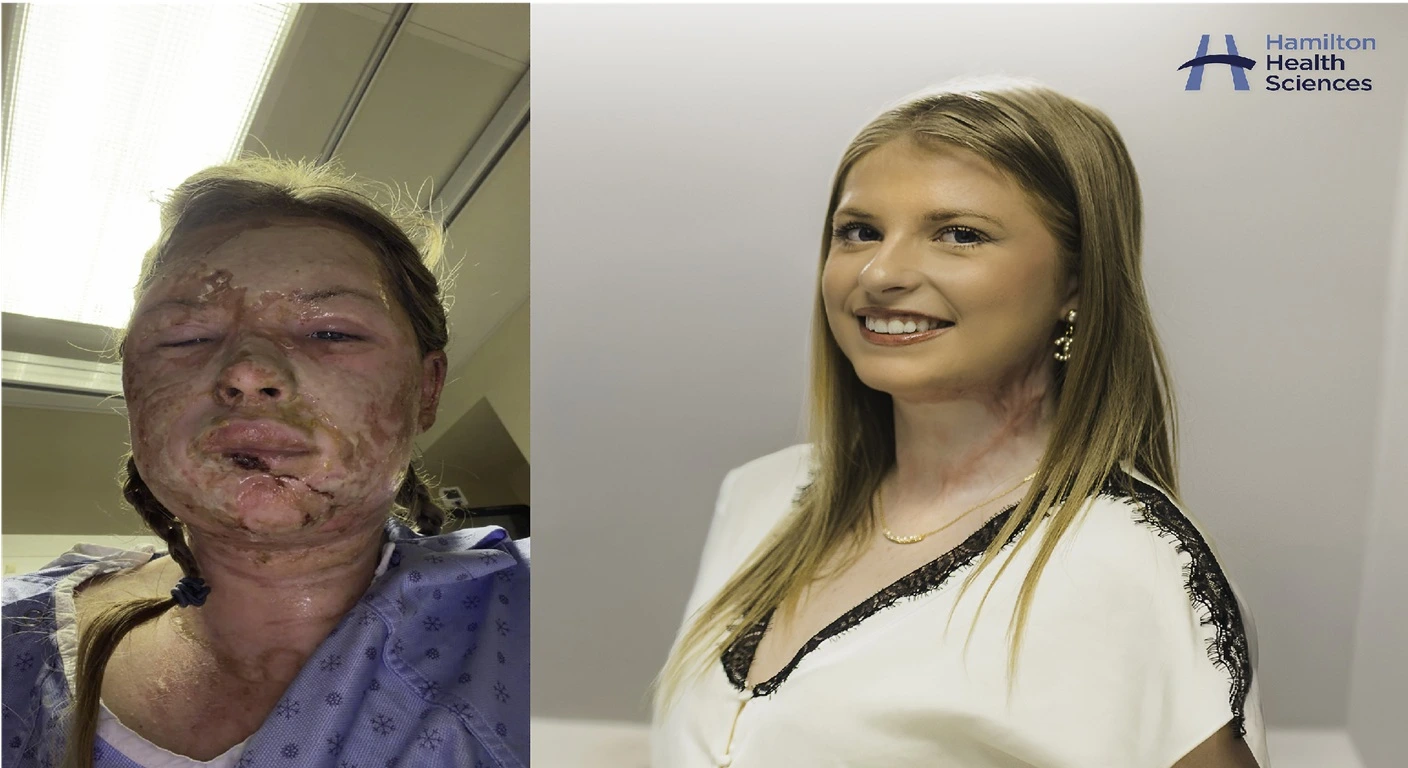
The treatment was used on 18-year-old Western University student Kaitlin Jeffrey of Toronto, who was critically injured in a house fire last December.
Exosome therapy
The novel treatment uses exosomes – tiny particles released by cells that carry signals from one cell to another, helping coordinate rapid healing and tissue repair and reducing inflammation. Typically collected from lab-grown cells, exosomes are injected into the injured areas to accelerate healing – much more effectively than the current standard of skin grafting, which can leave scarring and a patch-like appearance.
Although exosomes have been studied extensively in burn research, this is believed to be the first time the therapy has been used in a human burn patient. Clinical trials involving humans have used exosomes for other types of wound healing, with promising results.
Meet the surgeon
The surgery was performed by Dr. Marc Jeschke, vice president of research and innovation at HHS, burn surgeon and researcher, and a global authority on burns.
“My vision for Kaitlin was to avoid skin graft surgery to her face and neck at any cost,” said Dr. Jeschke.
Dr. Jeschke is also a professor of surgery at McMaster University, HHS’s key academic partner, and the medical director of the regional burn program at HHS’ Hamilton General Hospital – one of Ontario’s two regional burn centres where the most seriously injured patients in the province are treated. Co-located on the Hamilton General Hospital campus is HHS’ Centre for Burn Research, where teams are leading medical advancements and research into burn treatment, including exosome therapy.
After discussions with Jeffrey and her parents, Dr Jeschke submitted an urgent application to Health Canada to try exosome therapy on compassionate grounds. Following approval, Dr Jeschke and his HHS team carried out two exosome treatments several days apart, using one trillion exosomes sourced from the United States.
“You can do the best graft on the planet, but you won’t return the skin to normal. And, for a young person, a skin graft to the face and neck can be absolutely devastating,” said Dr Jeschke.
Jeffrey healed faster and achieved better results than another young student injured in the same fire whose burns, while serious, were less severe. The other student was not considered a candidate for exosome therapy because their injuries did not require skin grafting.
“It’s honestly a miracle. Being injured in the fire has also had deep impact on my mental health, and it’s something I’m continuing to deal with. But having such good results, particularly to my face, is helping me move forward,” said Jeffrey.
Exosome therapy: A new standard of care?
Dr Jeschke believes further research could pave the way for exosome therapy to become the new standard of care for burn patients in Canada and beyond.
“Like Dr. Jeschke, my family and I would love to see exosome therapy become the standard of care for patients like myself in Canada, so that when horrific things happen, it doesn’t change people’s lives forever,” Jeffrey said added.