


A major international clinical trial has begun enrolling patients in the Democratic Republic of the Congo (DRC) to evaluate potential treatments for Bundibugyo virus disease (BVD), a form of Ebola for which no approved therapy currently exists.
The PARTNERS (Platform Adaptive Randomised Trial for New and Repurposed Filovirus TreatmentS) study will assess whether two antiviral therapies – a monoclonal antibody (MBP134) and remdesivir – can improve survival in patients diagnosed with Bundibugyo virus disease. Researchers will also investigate whether combining the two therapies offers additional clinical benefits.
Sponsored by the World Health Organization (WHO), the trial is coordinated by the Institut National de Recherche Biomédicale (INRB) in the DRC, the Institute of Tropical Medicine in Belgium, and the University of Oxford in the United Kingdom, in collaboration with international research, clinical and humanitarian partners and with support from the Africa Centres for Disease Control and Prevention (Africa CDC).
The study comes as the DRC continues to battle the largest recorded outbreak of Bundibugyo virus disease. Since the outbreak began, more than 1,400 people have been diagnosed, nearly 210 patients have recovered, and almost 440 people have died.
Although effective therapies are available for some forms of Ebola virus disease, no treatment has yet been approved specifically for Bundibugyo virus disease, and no treatment has demonstrated efficacy across all Ebola virus species.
The investigational treatments were selected by the WHO Technical Advisory Group following a review of preclinical research, safety data and evidence from previous Ebola outbreak responses. Trial participants will receive close monitoring and follow-up for at least 28 days after enrolment.
Dr Tedros Adhanom Ghebreyesus, WHO Director-General, said, “Even without approved therapeutics, people are recovering from this disease, but of course, we could save many more lives with safe and effective therapeutics in our toolkit.”
“The PARTNERS trial, established with national authorities and scientific partners in record time, offers real hope that we can deliver concrete results for – and with – the communities at the heart of the outbreak,” he added.
The trial has been established as a platform trial to allow additional treatments to be added as they become available following assessment by the WHO Technical Advisory Group.
“We urgently need treatments that can help people affected by Bundibugyo virus disease. One of the key lessons from recent outbreaks is that research needs to happen alongside the response, not after it,” said Professor Amanda Rojek, PARTNERS Trial Operations Lead and Associate Professor of Health Emergencies, at the Pandemic Sciences Institute, University of Oxford.
“The PARTNERS trial gives us an opportunity to evaluate potential treatments during the outbreak itself, so that the evidence generated can help inform patient care when it is needed most – in months rather than years,” she added.
Prof Jean-Jacques Muyembe-Tamfum, Director-General of the Institut National de Recherche Biomédicale (INRB), said integrating the trial into clinical care would give patients access to promising investigational therapies while generating evidence to improve future outbreak responses.
The randomized, controlled study is enrolling patients of all ages with laboratory-confirmed Bundibugyo virus disease. Alongside the investigational therapies, all participants will receive early supportive care, including oral or intravenous fluids, electrolyte replacement, oxygen support, blood pressure management, and pain control in line with WHO treatment guidelines.
Dr Samuel Roger Kamba, Minister of Health of the DRC, said findings from this study could help identify more effective treatment options for both the current outbreak and future Ebola epidemics.
The trial is being conducted in partnership with the DRC Ministry of Public Health, ALIMA (The Alliance for International Medical Action) and Médecins Sans Frontières (MSF). An independent data and safety monitoring board will oversee the study.
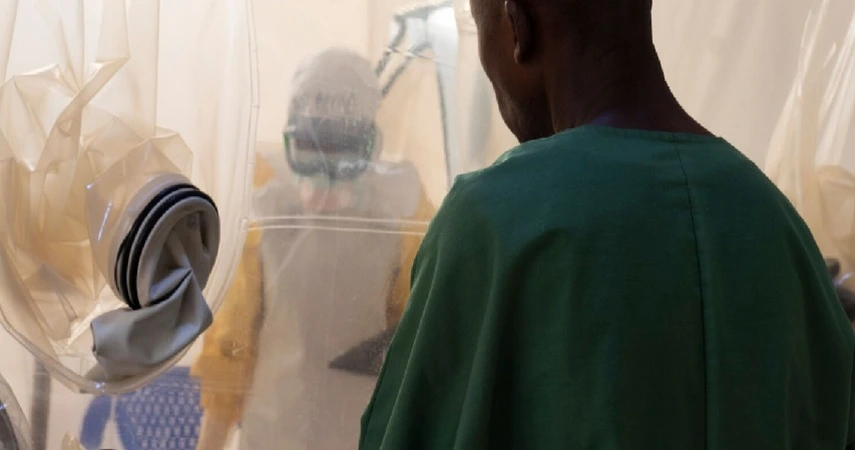
Photo: Health workers inside and outside of Ebola treatment “Cubes” at the ALIMA (Credit: WHO / Christopher Black)