



By Kumar Surender Sinwar, Founder & Chief Executive Officer, MLHealth360.
Every scan tells a story. The challenge today is not generating those stories, but ensuring they are heard in time.
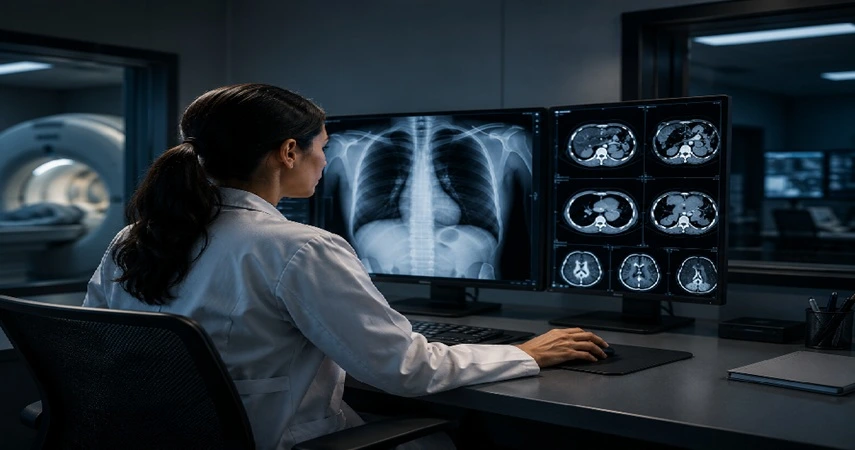
Medical imaging has become one of the most critical pillars of modern healthcare. From emergency medicine and oncology to neurology and preventive screening, clinical decisions increasingly rely on timely and accurate interpretation of imaging studies. As access to CT, MRI, and digital X-ray systems continues to expand, healthcare providers have more diagnostic information than ever before. The challenge, however, is keeping pace with the growing volume of images that require expert interpretation.
India reflects this reality acutely. While imaging infrastructure has expanded significantly across both public and private healthcare, the availability of specialist radiologists has not grown at the same pace. Rising scan volumes, increasing complexity of cases, and the need for faster clinical decisions are placing sustained pressure on radiology departments. The question is no longer whether more imaging can be performed. It is whether healthcare systems can interpret those studies quickly enough to support timely patient care.
The answer lies not in replacing radiologists, but in expanding diagnostic capacity through intelligently designed artificial intelligence (AI) that complements clinical expertise.
When Every Minute Matters
In diagnostics, delays are not merely operational inefficiencies. They can directly influence patient outcomes.
A patient presenting with suspected stroke, intracranial haemorrhage, pulmonary embolism, or major trauma requires immediate clinical attention. Yet radiologists working in high-volume hospitals often review hundreds of imaging studies during a single shift. In such environments, identifying which examinations require urgent attention can be just as important as interpreting them accurately.
AI-assisted workflow solutions are helping address this challenge by automatically analysing medical images as they are acquired, identifying findings associated with time-critical conditions, and prioritising those examinations for immediate review. Rather than replacing the radiologist, these systems help ensure that critical cases are less likely to wait behind routine studies.
The impact extends beyond faster reporting. Published clinical studies have demonstrated meaningful reductions in report turnaround times for urgent conditions such as pulmonary embolism through AI-assisted worklist prioritisation. More importantly, earlier identification enables clinicians to initiate treatment sooner, particularly in emergencies where every minute influences clinical outcomes.
Expanding Diagnostic Capacity, Not Replacing Expertise
The discussion around AI often centres on automation. In healthcare, the more important opportunity is capacity.
Radiologists spend considerable time performing repetitive yet essential tasks such as reviewing normal studies, making measurements, comparing prior examinations, documenting findings, and preparing structured reports. These activities are fundamental to quality care, but they also reduce the time available for complex interpretation, multidisciplinary discussions, and direct collaboration with treating clinicians.
AI can automate or streamline many of these workflow-intensive activities while maintaining clinician oversight. Intelligent triage, structured reporting support, automated measurements, and workflow orchestration help radiologists focus their expertise where it delivers the greatest clinical value.
Every hour saved from repetitive processes allows specialists to review more complex cases, improve reporting consistency, and support a greater number of patients. In this sense, AI is not replacing radiologists; it is extending their capacity to deliver timely, high-quality care.
Building More Efficient Imaging Workflows
The future of radiology depends as much on workflow as it does on image interpretation.
Hospitals today require solutions that integrate seamlessly into existing PACS, RIS, and clinical workflows without disrupting established practices. AI is increasingly becoming part of the diagnostic infrastructure rather than functioning as a standalone application. By supporting automated case prioritisation, intelligent worklist management, structured reporting, and faster communication of critical findings, AI helps create more efficient imaging pathways from acquisition to clinical decision-making.
These improvements benefit not only radiologists but also emergency physicians, neurologists, surgeons, and care teams who depend on timely diagnostic information to guide treatment decisions. As healthcare systems continue to experience rising imaging demand, improving workflow efficiency will become just as important as increasing imaging capacity itself.
Access to Expertise Beyond Major Centres
One of healthcare’s enduring challenges is ensuring that specialist expertise reaches patients regardless of geography.
Many district hospitals, smaller diagnostic centres, and rural healthcare facilities continue to operate with limited access to experienced radiologists. AI-supported imaging platforms, particularly when integrated with tele-radiology services, can help bridge this gap by assisting with case prioritisation, highlighting potentially significant findings, and enabling specialists to focus first on patients requiring urgent intervention.
While AI cannot replace clinical judgement, it can help extend the reach of specialist expertise across larger healthcare networks. This becomes particularly valuable in emergency imaging, where timely access to expert review may influence treatment pathways and patient outcomes.
The Future of Radiology is Smarter, Faster and More Collaborative
Healthcare has always depended on the judgement, experience, and expertise of clinicians. That will not change.
What is changing is the environment in which they work. Rising imaging volumes, increasing patient expectations, and growing pressure on healthcare systems require new ways of delivering diagnostic services without compromising quality or patient safety.
AI offers an opportunity to strengthen radiology by reducing workflow burdens, improving prioritisation of critical cases, and enabling faster clinical decision-making. The objective is not automation for its own sake, but creating healthcare systems where specialists can devote more of their expertise to the patients who need it most.
The future of radiology will not be defined by how many images artificial intelligence can analyse. It will be defined by how effectively technology supports clinicians in making faster, better-informed decisions. Ultimately, the greatest contribution AI can make is not replacing human expertise—it is helping that expertise reach more patients, more consistently, and at the moment it matters most.