








Scientists at the Jawaharlal Nehru Centre for Advanced Scientific Research (JNCASR) have developed a portable, low-cost and user-friendly diagnostic platform for detecting amyloid-β (Aβ), a key biomarker of Alzheimer’s disease (AD).
The smartphone-enabled platform, called ADxFluor, uses a fluorescence-responsive tiny molecule probe, TZ-48, to detect Aβ in biological samples. When TZ-48 interacts with Aβ, its fluorescence intensity changes. These changes can be captured and quantified using a dedicated smartphone application, enabling rapid and accessible detection.
Alzheimer’s disease is a progressive neurodegenerative disorder characterized by memory loss, cognitive decline and behavioural impairment. The accumulation of misfolded Aβ proteins, which form extracellular plaques in the brain, is considered a key pathological feature of the disease.
The National Institute on Aging-Alzheimer’s Association (NIA-AA) framework identifies Aβ, tau and neurodegeneration as core biomarkers for definitive AD diagnosis. As Aβ pathology is an early and relatively specific biomarker of Alzheimer’s disease, it is considered a more reliable diagnostic indicator.
While current diagnostic approaches, including positron emission tomography (PET) and magnetic resonance imaging (MRI) provide valuable diagnostic information, they are expensive, require specialized infrastructure and technical expertise. Moreover, their limited accessibility restricts widespread use. Blood-based assays for Aβ and tau are also complex and costly. This has created a need for affordable and scalable diagnostic technologies.
According to the researchers, TZ-48 enables highly selective, sensitive and differential detection of Aβ fibrils through turn-on fluorescence and distinct lifetime signatures.
The probe exhibited excellent blood-brain barrier permeability and robust labelling of Aβ plaques in transgenic mouse models of AD. It was also compatible with confocal laser scanning microscopy (CLSM) and fluorescence lifetime imaging microscopy (FLIM) for quantitative mapping of Aβ burden across disease stages. Beyond tissue imaging, TZ-48 could detect Aβ in cerebrospinal fluid and blood serum, distinguishing AD-model mice from healthy mice.
To facilitate clinical translation, the team developed ADxFluor, a smartphone-integrated platform that leverages the fluorescence response of TZ-48 for rapid and unbiased quantification of serum Aβ levels.
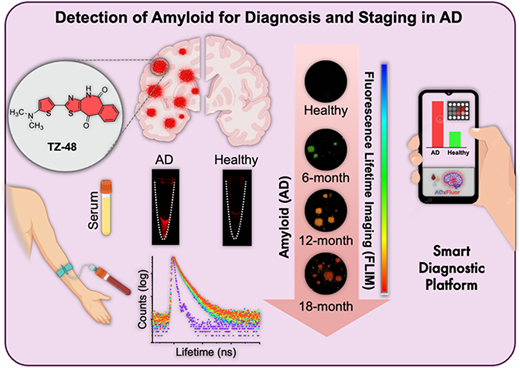
The integration of TZ-48 with the smartphone-based ADxFluor platform provides a portable, low-cost and user-friendly point-of-care diagnostic system for Alzheimer’s disease.
The researcher highlighted that the system could serve as a foundation for next-generation smart diagnostics for Alzheimer’s disease and other neurodegenerative diseases.
The research was published in the journal ACS Chemical Neuroscience.