





Royal Philips has received an award of up to USD 33.7 million under the Advanced Research Projects Agency for Health (ARPA-H), an agency within the US Department of Health and Human Services (HHS), Autonomous Interventions and Robotics (AIR) programme to advance AI-enabled robotic procedure automation for stroke care.
As part of the programme, Philips will collaborate with Johns Hopkins University and Boston University to develop technologies for remote-assisted and increasingly automated endovascular procedures, helping expand access to advanced stroke care.
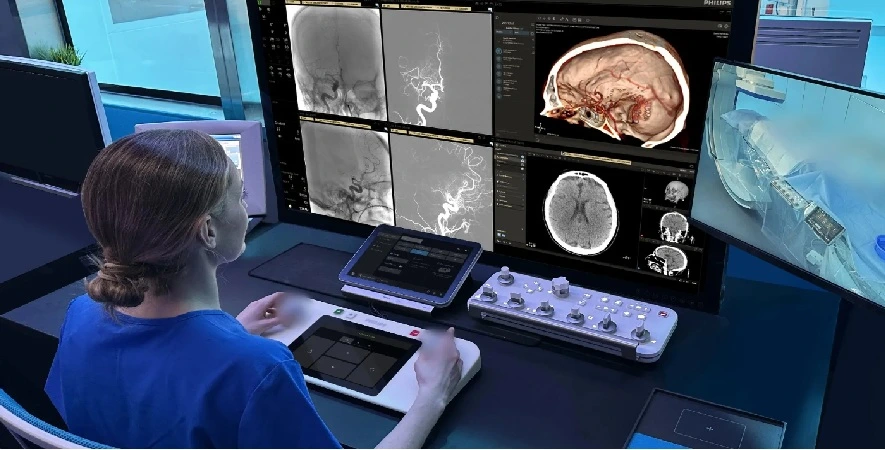
The company is advancing robotic procedure automation by integrating imaging, robotics, AI-enabled automation and smart interventional devices on its Azurion image-guided therapy platform. The project will develop technologies for endovascular navigation, robotic device control, image-based procedural guidance, workflow automation and remote intervention. These technologies are designed to support image-guided procedures while enabling increasing levels of supervised autonomy under expert clinical oversight.
“This ARPA-H programme accelerates our long-term vision for image-guided intervention. We’re helping shape a future where expert care is no longer limited by geography or workforce constraints. The goal is not to replace expertise, but to make expertise scalable and accessible,” said Bert van Meurs, chief business leader, Image-Guided Therapy, Philips.
Betsabeh Madani-Hermann, head of research, Philips, added, “Strong robotics and AI research has laid the scientific foundation for this effort, building on years of foundational work in image-guided and robotics procedural automation to help expand access to time-critical stroke intervention.”
The collaboration will combine Philips’ expertise in image-guided therapy and workflow automation with leading academic capabilities in robotics, clinical translation and procedure automation.
Under the programme, Johns Hopkins University will develop autonomous device navigation while Boston University will develop steerable catheters.
Dr. J Mocco, chair of Neurological Surgery at Weill Cornell Medicine and an additional clinical collaborator with Philips, said, “Robotics has the potential to improve precision and accuracy in endovascular stroke care, while also extending specialist expertise through remote procedures.”
Philips noted that globally, fewer than 3% of eligible patients with large-vessel occlusion receive mechanical thrombectomy, despite stroke remaining the world’s second leading cause of death and the third leading cause of death and disability combined.
Expanding access to these highly specialized procedures requires new approaches that combine imaging, robotics and AI to extend expert care beyond existing stroke centers.