





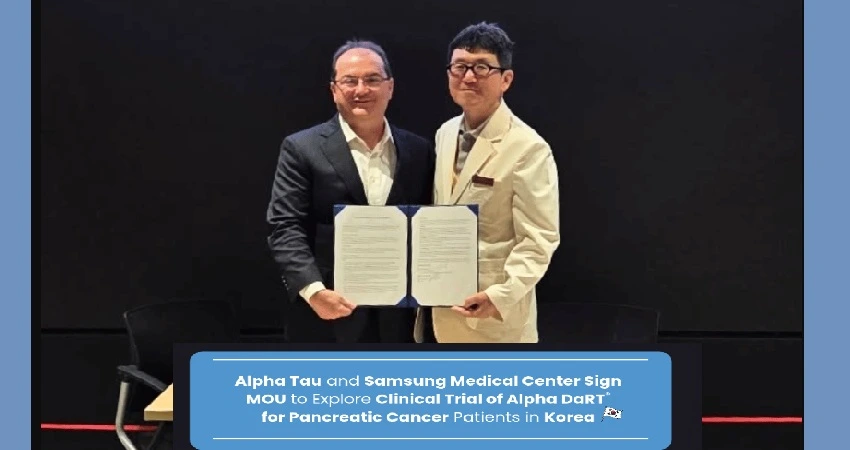
Photo: Uzi Sofer, CEO of Alpha Tau, and Hee-Chul Kim, EVP of Samsung Medical Center.
Israeli oncology therapeutics company Alpha Tau, developer of the alpha-radiation cancer therapy Alpha DaRT, has signed a memorandum of understanding (MOU) with Samsung Medical Center (SMC) in Seoul, South Korea, to explore a potential clinical trial in patients with pancreatic cancer.
Alpha DaRT (Diffusing Alpha-emitters Radiation Therapy) is being evaluated across a range of solid tumours, from superficial skin tumours to cancers in deep-seated organs. The therapy is being investigated as a standalone treatment and in combination with systemic agents, as well as for metastatic and inoperable disease.
Any clinical trial in South Korea would be subject to regulatory and ethics committee approvals, the company said.
Uzi Sofer, CEO of Alpha Tau, said the agreement with Samsung Medical Center marked an important step towards expanding access to Alpha DaRT for cancer patients worldwide.
“With Korea, our pancreatic cancer programme could potentially span six countries across North America, Europe, the Middle East and Asia,” he said.
Hee-Chul Kim, executive vice-president of Samsung Medical Center and general director of Samsung Comprehensive Cancer Center (SCCC), highlighted the significant challenges associated with treating pancreatic cancer, noting that treatment options remain limited for many patients.
“We hope this MOU will help us explore new possibilities for these patients. We will carefully review the clinical application of Alpha DaRT and do our best to strengthen our own research capabilities,” Kim said.
How Alpha DaRT works
Alpha DaRT is designed to deliver targeted alpha radiation to solid tumours through the intratumoral placement of tiny sources impregnated with radium-224.
As radium-224 decays, it releases short-lived daughter radioisotopes that disperse within the tumour and emit high-energy alpha particles intended to destroy cancer cells. Because alpha particles travel only a short distance, the therapeutic effect is limited to within the tumour while minimising damage to surrounding healthy tissue.
The technology is being investigated across multiple solid tumour types, making it a potential tumour-agnostic approach. Alpha DaRT was initially developed by Prof. Itzhak Kelson and Prof. Yona Keisari of Tel Aviv University.
Alpha Tau’s clinical development programme
Alpha Tau is conducting clinical studies of Alpha DaRT in the US, Canada, Israel, Italy and France. Its US clinical studies are being conducted under Investigational Device Exemptions (IDEs) granted by the US Food and Drug Administration (FDA).
The IDE designation means that the FDA has already reviewed the technology, safety data, and clinical plans, and has authorised the company to evaluate it in patients in the context of clinical trials. The Alpha DaRT is still not authorised or available for commercial use in the US.
The company said it had reached a milestone of five simultaneously active IDEs. Its clinical development programme covers several cancer types, including pancreatic, brain, skin, lung, prostate, head and neck, and liver cancers.
The programme includes studies evaluating Alpha DaRT in recurrent cutaneous squamous cell carcinoma, malignant cutaneous tumours, mucosal and superficial soft-tissue neoplasms, recurrent lung cancer, locally recurrent prostate cancer, head and neck squamous cell carcinoma, liver metastases and recurrent glioblastoma.
Pancreatic cancer studies include ACAPELLA (Alpha DaRT for Cancer of the Pancreas in Locally Advanced Adenocarcinoma), as well as trials investigating Alpha DaRT in locally advanced pancreatic cancer and its use in combination with chemotherapy for locally advanced and metastatic disease.
Alpha Tau’s pancreatic cancer programme is currently being pursued in the US, France, Italy, Canada and Israel. The potential South Korean trial could expand the programme’s geographic reach to a sixth country.
Founded in 2016, Alpha Tau focuses on the research and development of intratumoral alpha-emitting radiotherapeutics for multiple solid tumour types, including cancers for which treatment options are limited or unavailable.