





The World Health Organization (WHO) has identified several potential vaccines and therapeutics for the prevention and treatment of Ebola disease caused by the Bundibugyo virus, amid the ongoing outbreak in the Democratic Republic of the Congo (DRC), with cases also reported in Uganda.
In response to the outbreak, the WHO convened multiple expert and advisory groups to assess candidate products for Bundibugyo virus disease (BVD). The experts recommended that all identified vaccines and therapeutics should be used only within clinical trials to generate robust data and ensure safe, ethical, and effective research.
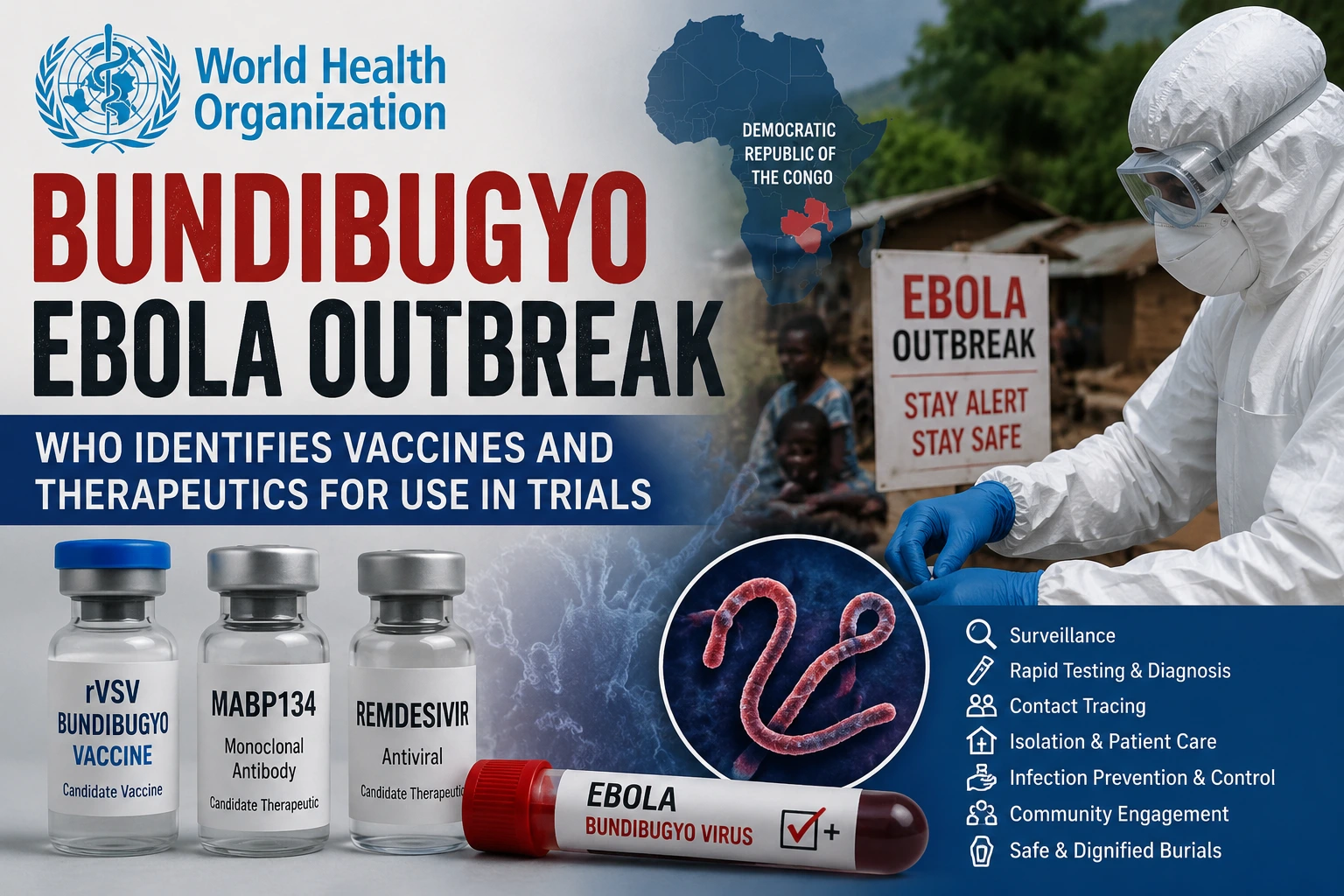
For treatment, they prioritized three candidate therapeutics for evaluation in clinical trials among confirmed BVD cases. These include monoclonal antibodies MBP134, developed by Mapp Biopharmaceutical, and Maftivimab from Regeneron, as well as the antiviral remdesivir from Gilead Sciences. The experts also recommended evaluating combination therapy using a monoclonal antibody alongside remdesivir.
For prevention, Gilead’s experimental oral antiviral obeldesivir was identified as a priority candidate for post-exposure prophylaxis among contacts of confirmed and probable cases. However, the agency noted that the success of this approach depends on effective contact tracing, which remains operationally challenging in some affected regions of the DRC.
Among vaccine candidates, the single-dose rVSV Bundibugyo vaccine, being developed by the International AIDS Vaccine Initiative (IAVI), was identified as the most promising option. However, the WHO said the vaccine is unlikely to be ready for clinical trials for another seven to nine months.
Another vaccine candidate, ChAdOx1 Bundibugyo, being developed by Oxford University and the Serum Institute of India, could be available for efficacy assessment in clinical trials within two to three months. However, additional animal data are still needed to support further prioritization.
The WHO experts also reviewed the potential use of Merck’s Ervebo, the only licensed Ebola vaccine. Ervebo is approved for use during outbreaks caused by the Zaire ebolavirus species, the most common Ebola virus strain in Africa. However, the WHO advised against its use outside research settings for the current outbreak, as “evidence on cross-protection to other Ebola virus species remains limited and inconclusive.”
The agency said it is working closely with the governments of the DRC and Uganda, along with other scientific partners such as the Africa CDC and French National Agency for Research on AIDS and Viral Hepatitis, to facilitate clinical research on the prioritized products.
Currently, there are no licensed vaccines or therapeutics specifically approved for the prevention or treatment of Bundibugyo virus disease.
In the meantime, the WHO emphasized that controlling transmission remains the immediate priority, using established Ebola response measures such as disease surveillance, rapid testing and diagnosis, contact tracing, isolation and patient care, infection prevention and control, community engagement, and safe and dignified burials.