



Commerce and Industry Minister Piyush Goyal has called for faster regulatory approvals, improved access to finance and shared infrastructure to accelerate India’s bioeconomy and strengthen its biopharma startup ecosystem.
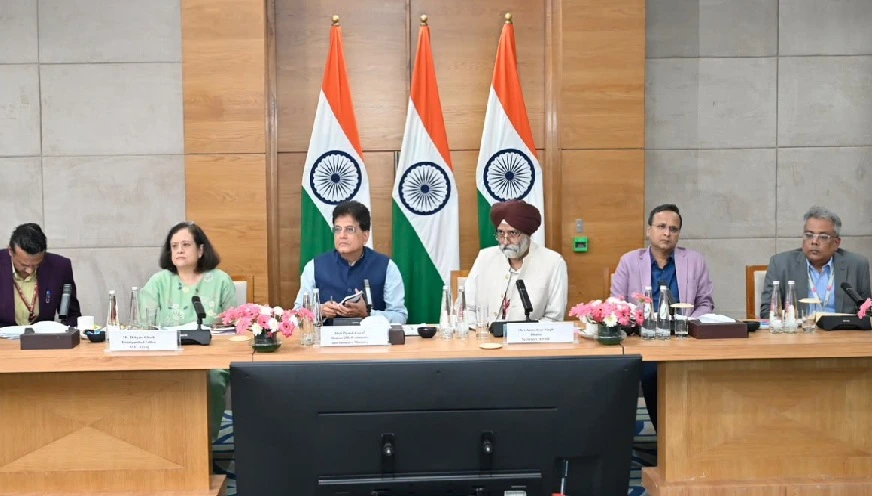
Goyal chaired a high-level roundtable on “India’s Bioeconomy Opportunity: Role of Startups in Driving Innovation and Growth” at Vanijya Bhawan, New Delhi. Organised by the Department for Promotion of Industry and Internal Trade (DPIIT), in collaboration with NITI Aayog and NITI Frontier Tech Hub, the meeting brought together policymakers, industry leaders and biopharma startups to discuss measures to drive innovation and growth in the sector.
In his address, Goyal emphasised the need to leverage India’s scientific capabilities and entrepreneurial talent to position the country as a global leader in the bioeconomy. He also called for stronger industry–academia–Government collaboration and time-bound action on the recommendations emerging from the roundtable.
Discussions focused on streamlining regulations, expediting approvals and introducing mechanisms such as a proposed Regulatory Sandbox and Single Window Clearance. Participants also explored global regulatory alignment and simplified patent application processes to support startup innovation.
The roundtable highlighted the role of Biopharma SHAKTI, announced in the Union Budget 2026–27, in strengthening the sector. Participants stressed the need for shared laboratories, testing facilities and clinical trial infrastructure to reduce costs and help startups scale their innovations.
Distinguished Fellow at NITI Aayog, Debjani Ghosh, underscored the importance of collaboration among startups, industry, academia and Government in building a globally competitive bioeconomy.
NITI Aayog Member Prof. Gobardhan Das emphasised strengthening research capabilities and translating scientific discoveries into commercially viable products.
The discussions also covered measures to strengthen domestic life sciences manufacturing, expedite customs clearance for laboratory equipment and reagents, and simplify access to Government schemes and regulatory support.
Participants called for stronger inter-ministerial coordination to enable coherent policy interventions and faster resolution of sector-specific challenges.