






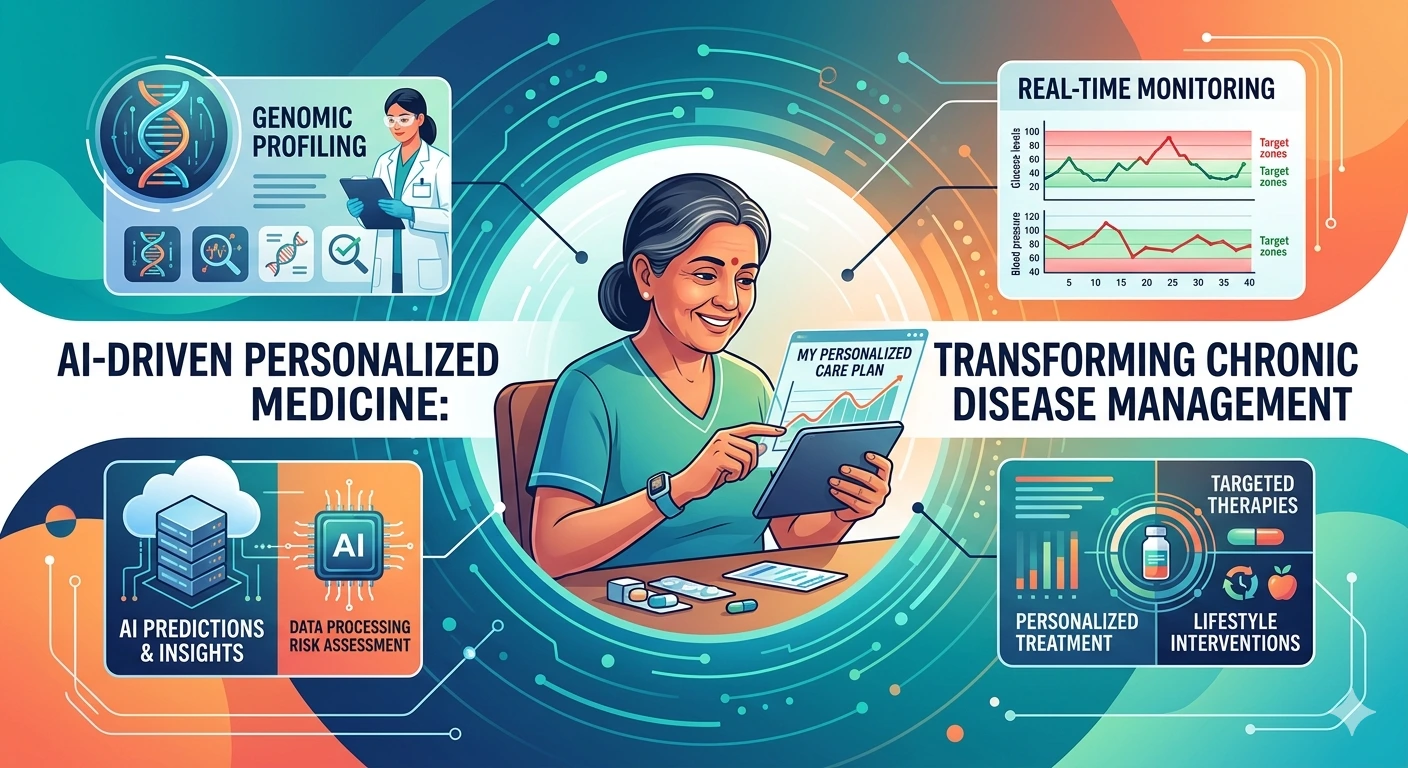
Management of chronic diseases is getting easier, thanks to the advent of personalized medicine and the application of Artificial intelligence (AI). The integration of AI and personalized medicine has significantly improved diagnostic accuracy, enhanced drug efficacy and reduced adverse effects. AI algorithms can process vast patient data—including genetic information, electronic health records (EHRs), medical imaging, and real-time inputs from wearable devices — helping doctors detect diseases earlier and plan treatment more accurately.
Let’s explore how AI optimizes the management of chronic diseases likediabetes and heart disease.
AI in Chronic Disease Management
In diabetes care, AI-powered tools, such as predictive analytics, machine learning, and real-time monitoring, have shown a significant impact. For example, studies have demonstrated that Machine learning (ML) models can predict blood glucose (BG) levels in patients with diabetes mellitus (DM), enabling early detection of hypoglycemia and hyperglycemia, and thus timely interventions.
Another notable application of AI in personalised medicine is pharmacogenomics – the study of how genetic variations influence an individual’s response to drugs. Leveraging machine learning and deep learning algorithms, AI can analyze multiple aspects of genetic information and predict patient responses to medications. This allows healthcare providers to develop personalized therapeutic models that will be most effective for individual patients, thereby reducing the incidence of adverse drug reactions (ADRs). In addition, AI supports patient self-management by offering personalized diet modifications, physical activity changes, and insulin usage.
Studies assessing AI-based interventions for personalized diabetes care have shown a significant reduction in glycated hemoglobin (HbA1c). A review of several such studies has concluded that AI-based interventions hold promise for enhancing glycemic control and patient self-management in diabetes care.
In cardiology, AI is particularly known for accuracy and efficiency in interpreting medical images. AI algorithms, like deep learning models, can interpret electrocardiograms (ECGs), magnetic resonance imaging (MRI), and computed tomography (CT) scans with remarkable precision. This enables physicians to identify changes and patterns that indicate early-stage heart diseases, such as myocardial fibrosis or plaque characteristics, which are often missed in traditional assessments.
Ethical considerations
Despite its promise, the integration of AI in healthcare poses some ethical and operational challenges. Data privacy remains a critical concern, as it involves patients’ personal information. Therefore, establishing robust data management systems becomes crucial to ensure the correct handling of patient data and its protection.
Furthermore, it is essential to ensure equal access to AI-driven healthcare innovations, lower cost of implementation and provide proper workforce training to encourage widespread adoption.
It will require collaborative efforts between policymakers, healthcare providers, technologists, and researchers to address these challenges and ensure that AI is both ethical and inclusive.
Notably, the Indian Council of Medical Research (ICMR) has introduced ethical guidelines for the application of AI in biomedical research and healthcare.
“The adoption of AI technology in healthcare is growing in India. However, AI as data-driven technology has many potential ethical challenges which include algorithmic transparency and explainability, clarity on liability, accountability and oversight, bias and discrimination”, said Dr Rajiv Bahl, Director General, ICMR.
These guidelines provide a framework for ethical decision-making in medical AI during the development, deployment, and adoption of AI-based solutions. Developed through extensive discussions with experts and ethicists, the guidelines include sections on ethical principles, guiding principles for stakeholders, an ethics review process, governance of AI use, and informed consent.
Aimed at strengthening its digital health ecosystem, India also launched the Ayushman Bharat Digital Mission (ABDM) to integrate healthcare service providers and patients through unique health IDs. Another important step being taken by the government is the Digital Health Incentive Scheme, which encourages healthcare providers to adopt digital health solutions by offering financial incentives. Together, these initiatives will help build the foundation for scalable AI integration.