






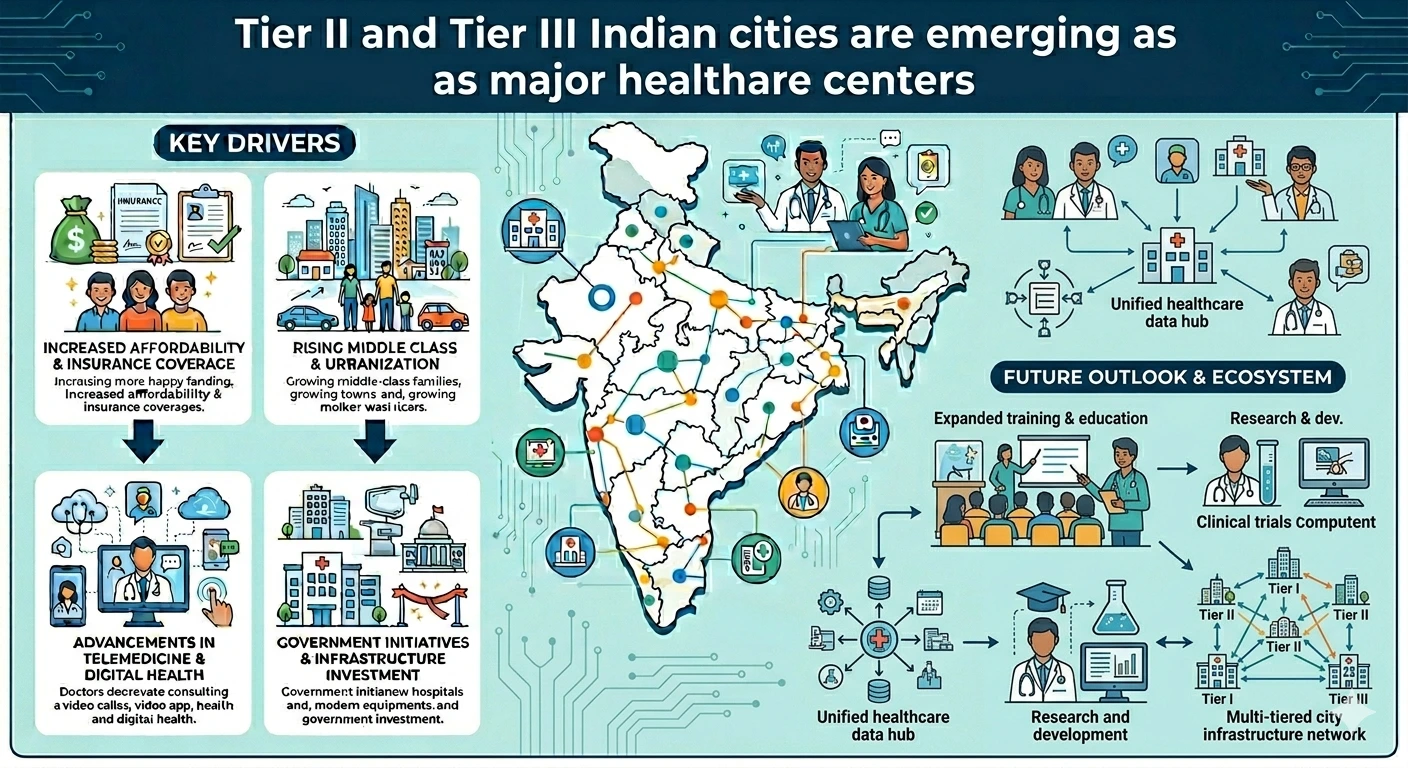
Healthcare is one of the biggest sectors in India, contributing a huge amount of revenue to the nation. The rising incidence of illnesses, affordable healthcare delivery methods, technological developments, and government health programmes are some of the factors contributing to the growth of the healthcare industry. We have seen a dramatic change in India’s healthcare system over the past few years. Today, advanced healthcare is no longer limited to metropolitan and tier I cities; Tier II and Tier III cities are emerging as major healthcare centers.
Key Drivers of Healthcare Expansion in India
There’s no doubt that the per capita income of the middle-class population in tier II and III cities is improving. This, coupled with the improving infrastructure, is leading to an increasing demand for better healthcare facilities. Also, with social media playing a big role in promoting health awareness, people are increasingly seeking quality healthcare.
Another reason is that the healthcare system in tier I or metro cities has reached a saturation point, which is making multispecialty hospitals look towards tier II and III cities for potential business expansion. The lack of land in metropolitan areas is also pushing healthcare companies to move to the tier II healthcare sector.
Government initiatives have also contributed to transforming tier II and tier III cities into healthcare hubs to a large extent. The AB PM-JAY health assurance (Ayushman Bharat Pradhan Mantri Jan Arogya Yojana) scheme, which provides coverage of Rs. 5 lakh per family annually, is now making quality healthcare accessible to underserved populations. Almost 70% of hospitals in the tier II and tier III cities are already empanelled under Ayushman Bharat as of 2025.
In addition, the increasing private sector investment and the integration of advanced healthcare technology, such as telemedicine, AI-powered diagnostics, robotics, personalised medicine, Electronic Medical Records (EHRs), and remote monitoring systems, are revolutionising the healthcare landscape in tier II and tier III cities.
Bridge The Healthcare Gap
The emerging healthcare centres in the tier II and tier III cities are helping bridge the healthcare gap between rural and urban India by improving accessibility and affordability to advanced treatments across the nation. Additionally, they are helping address India’s rising burden of non-communicable diseases in semi-urban areas, which account for over 65% of the nation’s population.
NCDs— particularly cardiovascular diseases, chronic respiratory conditions, cancer, and diabetes— are known to be the leading causes of morbidity and mortality worldwide. The World Health Organization (WHO) estimates that nearly 73% of NCD-related deaths occur in low- and middle-income countries. India is one of the most affected countries.
The Indian Council of Medical Research (ICMR) data shows that the proportion of deaths due to NCDs rose from 37.9% in 1990 to 61.8% in 2016. Concerningly, we are seeing an increasing incidence of these diseases among young adults.
The government’s recognition of the pressing need to address this issue and its efforts are noteworthy. The National Programme for Prevention and Control of Cancer, Diabetes, Cardiovascular Diseases and Stroke (NPCDCS) launched under the National Health Mission in 2010, is a great initiative. So far, the programme has facilitated the establishment of hundreds of NCD clinics at district and community health centre levels, which have helped improve early detection and management of non-communicable diseases in areas that remained highly underserved until now.
At the same time, the expansion of private hospital chains beyond metropolitan areas further supports efforts to address this rising health challenge.
Persisting Challenges
However, challenges remain in building robust healthcare ecosystems in tier II & III cities. Shortage of healthcare professionals is the most critical challenge. According to The Health Dynamics of India 2022-23 report released by the Union Health Ministry, there is an alarming shortage of nearly 80% of specialist doctors at Community Health Centres (CHCs) in rural regions. Infrastructure gaps and uneven distribution of resources further add to the demand–supply imbalance.
The Road Ahead
Development of advanced healthcare facilities in Tier II and Tier III cities remains crucial to achieving India’s goal of universal and equitable healthcare, as well as addressing these gaps.By aligning investments, strengthening infrastructure, and leveraging technology, India can build a robust, future-ready healthcare system.