




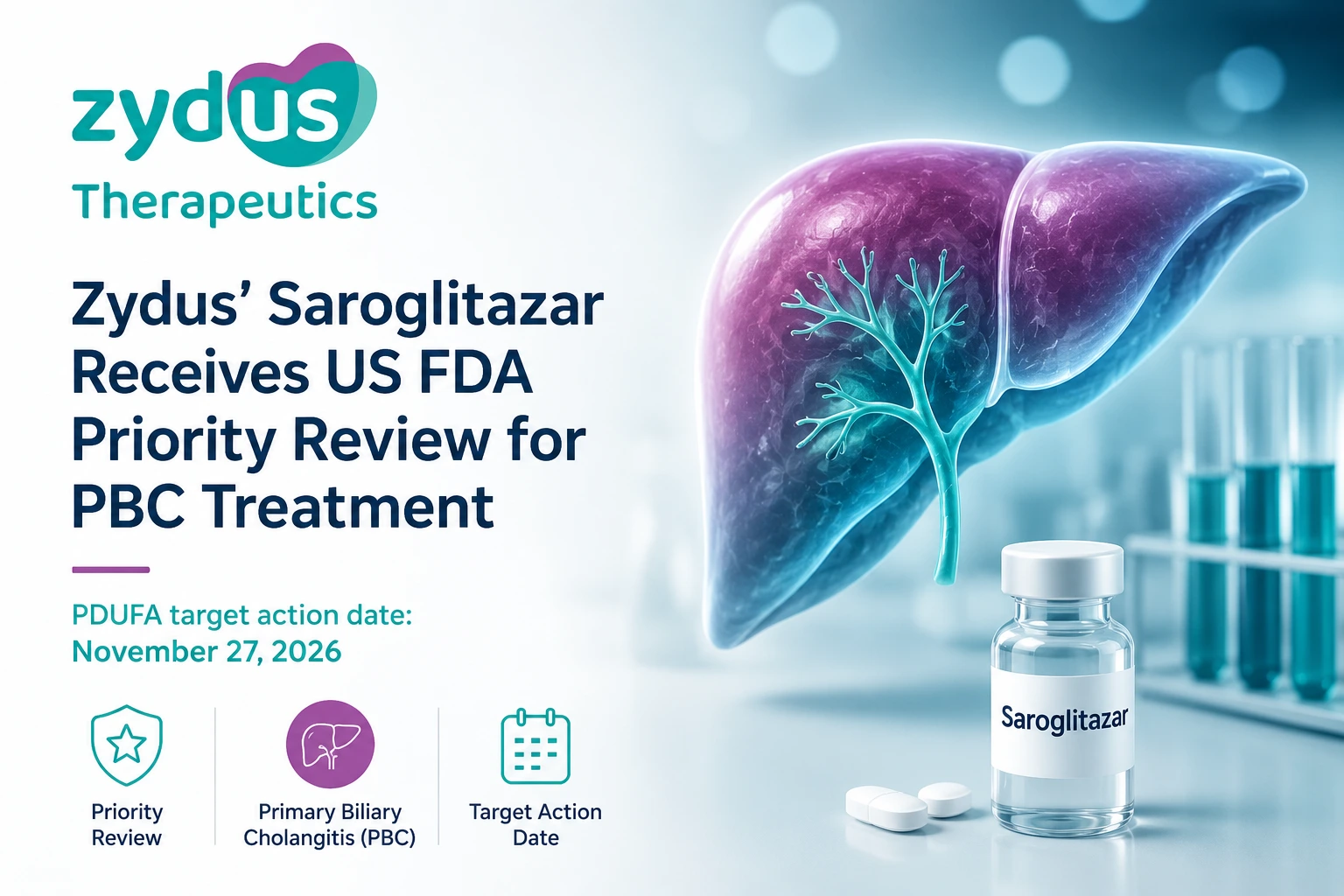
Zydus Therapeutics, a wholly owned subsidiary of Zydus Lifesciences, has received Priority Review from the US Food and Drug Administration (US FDA) for the New Drug Application (NDA) of saroglitazar for the treatment of Primary Biliary Cholangitis (PBC).
PBC is a rare, progressive autoimmune disease that gradually destroys the bile ducts, resulting in the accumulation of bile in the liver. Over time, this can lead to fibrosis, cirrhosis, liver transplantation, or death. The condition is characterized by elevated biochemical markers, particularly alkaline phosphatase (ALP) and bilirubin, while patients often experience severe itching (pruritus) and fatigue.
Saroglitazar is proposed as a combination therapy with ursodeoxycholic acid (UDCA) for adults with an inadequate response to UDCA, and as a monotherapy option for patients who cannot tolerate UDCA.
The US FDA has assigned a Prescription Drug User Fee Act (PDUFA) target action date of November 27, 2026. Priority Review is granted to therapies that may offer significant improvements in the safety or effectiveness of treatments, diagnosis, or prevention of serious conditions.
“The acceptance of our NDA with Priority Review highlights the significant unmet need that exists for patients with PBC and represents an important step in the path to making saroglitazar available in the US,” said Managing Director of Zydus Lifesciences, Dr. Sharvil Patel.
“We look forward to collaborating with the US FDA during the NDA Priority Review process and will, in parallel, continue to build our medical affairs and commercialization capabilities towards a potential US launch in the fourth quarter of FY 27,” Patel added.
Saroglitazar is a novel Peroxisome Proliferator-Activated Receptor (PPAR) α/γ agonist currently under investigation for the treatment of PBC. Its dual-action biological profile is designed to target both bile acid toxicity and liver inflammation. The therapy has already received Orphan Drug Designation and Fast Track Designation from the US FDA for PBC treatment.
The NDA submission is supported by results from the Phase 3 EPICS-III trial, a randomized, double-blind, placebo-controlled study evaluating saroglitazar in adult patients with PBC who had shown an inadequate response to or intolerance of UDCA.
“EPICS-III is a registrational study that tested saroglitazar as a second-line treatment in patients with PBC. The study met its primary endpoint, demonstrating a clinically meaningful biochemical response, along with a favourable safety and tolerability profile,” said Raj Vuppalanchi, Professor of Medicine at Indiana University School of Medicine and Global Principal Investigator for the EPICS-III study.
In the trial involving 148 patients, saroglitazar met the primary endpoint of biochemical response at Week 52, with 56.7 per cent of treated patients achieving biochemical response compared with 9.8 per cent in the placebo group — a treatment difference of 48 per cent.
The therapy also demonstrated a 40.1 per cent treatment difference in mean ALP levels, reducing ALP by 33.5 per cent, compared with a 6.5 per cent increase in patients receiving placebo.
“The magnitude of separation between saroglitazar and placebo in biochemical response is a clinically meaningful result for patients whose disease continues to progress on UDCA,” said Dr. Kris Kowdley, Director, Liver Institute Northwest.
“Achieving meaningful reductions in ALP is an important treatment goal in PBC as it is a surrogate marker predictive of long-term outcomes. These results suggest saroglitazar may provide a promising therapeutic option for patients with a suboptimal response to UDCA alone, when ALP continues to rise above the target,” Kowdley added.
Saroglitazar was generally well tolerated during the EPICS-III trial, with most treatment-emergent adverse events reported as mild to moderate in nature.
The EPICS-III trial Phase 3 results will be presented during a late-breaking session at the European Association for the Study of the Liver (EASL) Congress in Barcelona, Spain, on May 30, 2026.
Headquartered in Pennington, New Jersey, Zydus Therapeutics, is a clinical-stage, specialty- focused biopharmaceutical company developing transformative treatments for rare and serious liver diseases, including PBC and Metabolic Dysfunction-Associated Steatohepatitis (MASH).