



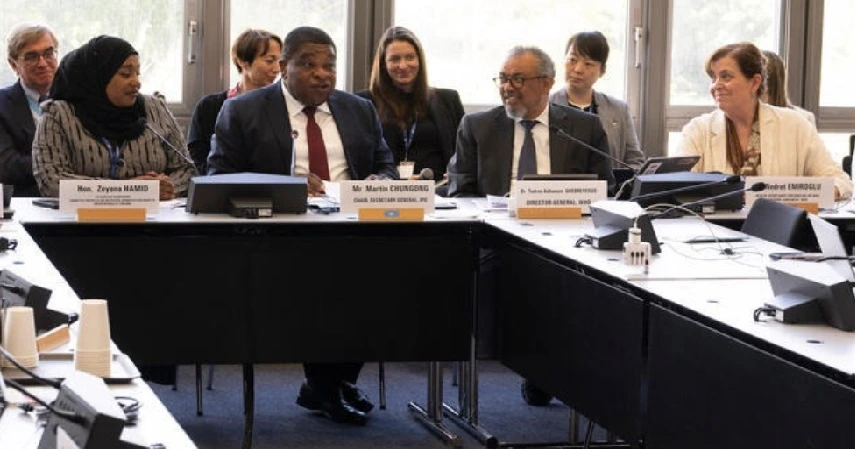
WHO Director-General Dr Tedros Adhanom Ghebreyesus has called on parliamentarians to play a leading role in transforming global health commitments into tangible outcomes, emphasizing that implementation is the key to saving lives.
Addressing the Global Parliamentary Forum during the 79th World Health Assembly in Geneva, Switzerland, on May 20, 2026, he stressed that parliaments serve as the vital link between international commitments and the everyday health needs of people.
Speaking at the Forum, Dr Tedros said, “Global agreements do not save lives – implementation does.”
“Parliaments are the bridge between global commitments and people’s daily lives. You adopt the laws, approve the budgets, and hold governments accountable,” he added.
The Forum brought together parliamentarians, Member State representatives, civil society organizations, and development partners to strengthen parliamentary leadership in advancing implementation of the WHO Pandemic Agreement and sustainable financing for health.
Jointly convened by the World Health Organization (WHO) and the Inter-Parliamentary Union (IPU), the Global Parliamentary Forum was first launched during last year’s World Health Assembly. It has now been established as an annual platform for parliamentary engagement at the heart of the Assembly.
The initiative was introduced under the leadership of Dr Tedros, who recognized the critical role of parliamentarians in advancing health priorities at the national level and championed the creation of a dedicated parliamentary platform within the World Health Assembly.
Held under the theme “From Commitment to Action: Advancing Parliamentary Leadership for the WHO Pandemic Agreement Implementation and Sustainable Financing for Health,” the Forum was co-chaired by Martin Chungong, IPU Secretary-General, and Dr Zeyana Hamid, Vice-Chairperson of the Committee for Health and HIV Affairs of the Parliament of the United Republic of Tanzania.
Both leaders underscored the critical role of parliaments in translating global commitments into concrete action through legislation, policymaking, oversight and budgetary decisions.
“Sustainable financing for health is not simply a technical discussion. It is a political and moral choice. Investment in health is an investment in security, stability and sustainable development,” said Chungong.
During the Forum, Dr Nedret Emiroglu, Head of the Secretariat for the Intergovernmental Working Group (IGWG) on the WHO Pandemic Agreement, provided an update on the Agreement’s progress, including ongoing negotiations on the Pathogen Access and Benefit-Sharing (PABS) Annex, and highlighted the central role of parliaments in supporting its signature, ratification and implementation at the national level.
Dr Kalipso Chalkidou, Director of the Performance, Financing and Delivery Department at WHO, highlighted the importance of sustainable financing for health and the role of parliaments in mobilizing domestic resources to strengthen pandemic preparedness and resilient health systems. She also pointed to the strategic use of health taxes as both public health and fiscal instruments.