


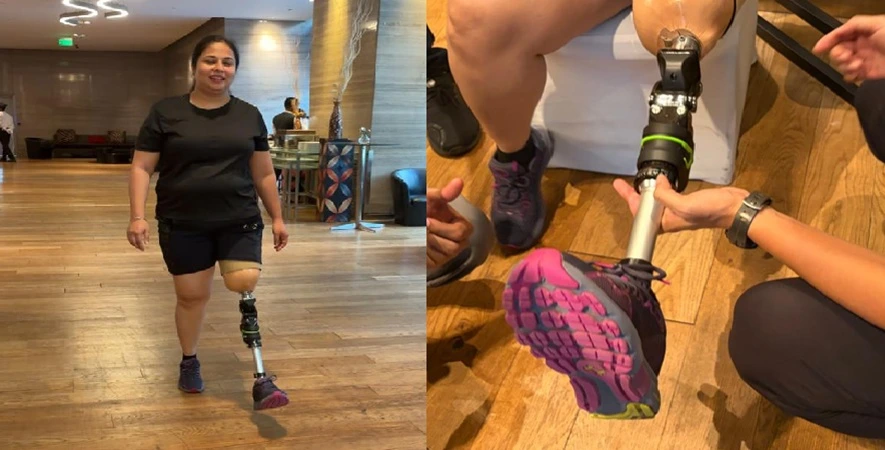
Sandeep Kaur is a marathon runner and Paralympic athlete. She treks, paraglides, and dances with her prosthetic limb. She has achieved what many able-bodied people might find challenging, driven by her unwavering determination and supported by technology.
This is how an advanced prosthetic limb can transform an amputee’s life. Sadly, many amputees in India are unable to lead a quality life because they cannot afford advanced, functional prosthetic limbs, and most health insurance policies in India do not cover prostheses.
Sandeep lost her left leg at the age of 15 in 2003, when a pillar fell on her while she was trying to save two children. Her family somehow managed to buy her a prosthetic limb, which cost several lakhs of rupees, so that she could continue her studies and eventually secure a government job.
According to Sandeep, an advanced running blade costs around Rs 10–12 lakh and can go up to Rs 20 lakh, while a basic functional prosthetic limb costs around Rs 5–6 lakh.
She received her running blade free of cost through a tie-up between her office and an artificial limb centre. For many patients, however, access to advanced prosthetic options remains a major challenge.
Sandeep said, “There should be insurance coverage for prosthetic limbs, and the government should support the development of more advanced prosthetic technology, as not everyone can afford prostheses offered by private companies.”
Affordability Challenge
Industry experts are also calling for full insurance coverage of prosthetic and orthotic services to help more amputees lead independent lives and contribute to the country’s economy.
“In India, prosthetic and orthotic services are not yet fully covered by insurance. If these services were covered, affordability would be less of a concern,” said Dr. MC Dash, National President, Orthotics & Prosthetics Association of India (OPAI).
He said the association is working actively to include prosthetic and orthotic services under insurance coverage, just like other healthcare services.
“This would make quality prosthetic and orthotic products more accessible to everyone,” he said.
Kavinder Beniwal, COO, Motorica India, agreed that insurance coverage could make advanced prosthetic technologies more accessible to patients and transform their lives.
He said, “Many of these patients come from the labour class. They are working on factory floors or, in many cases, in crop harvesting. We get a huge number of patients from Punjab, especially during the wheat harvesting season. During the harvesting season, these kinds of accidents happen.
“The government is already taking a lot of good initiatives. If prosthetic care could be included as part of the reimbursement system for insurance under Ayushman Bharat or another appropriate scheme. This could bring the benefits to a broader population and address the affordability challenge.”
“Right now, many of these patients are paying out of pocket,” Beniwal said, adding that Motorica India is already engaging with the government on the issue.
How Effective are Government Schemes?
Dr. Dash said government schemes provide prosthetic and orthotic products, but many people do not avail them due to concerns about quality.
“Those who have no other option rely on government-provided prostheses and orthoses,” he said.
“Patients choose solutions based on their activity levels. For example, a prosthesis suitable for an office-going person may not meet the needs of an athlete. If prosthetics are also covered by insurance, more people will be able to access quality products,” he added.
While free or low-cost prosthetic limbs are offered through government schemes, Beniwal said that many of these devices have limited functionality.
ALIMCO—the Artificial Limbs Manufacturing Corporation of India—is a government enterprise and a major implementing agency under the ADIP (Assistance to Disabled Persons for Purchase/Fitting of Aids/Appliances) scheme. Through ALIMCO and other implementing agencies, the government conducts camps across communities and provides assistive devices, including prosthetic and orthotic appliances, free of cost or at subsidised rates to eligible beneficiaries.
However, Beniwal said that many of these products are relatively basic.
“Many times, the prosthetic feet do not have sufficient movement. Even the hands are not bionic; they are mainly manual or conventional prosthetic hands. These devices are provided largely because of budget constraints,” he said.
Sandeep said some amputees use the Jaipur Foot and spend the rest of their lives with it because it is provided free of cost.
“I also used it for some time, but it was difficult and painful to walk with it for the whole day, and it was not functional enough for me. With my current prosthesis, I can trek in tough terrain, go paragliding and participate in long marathons,” she added.
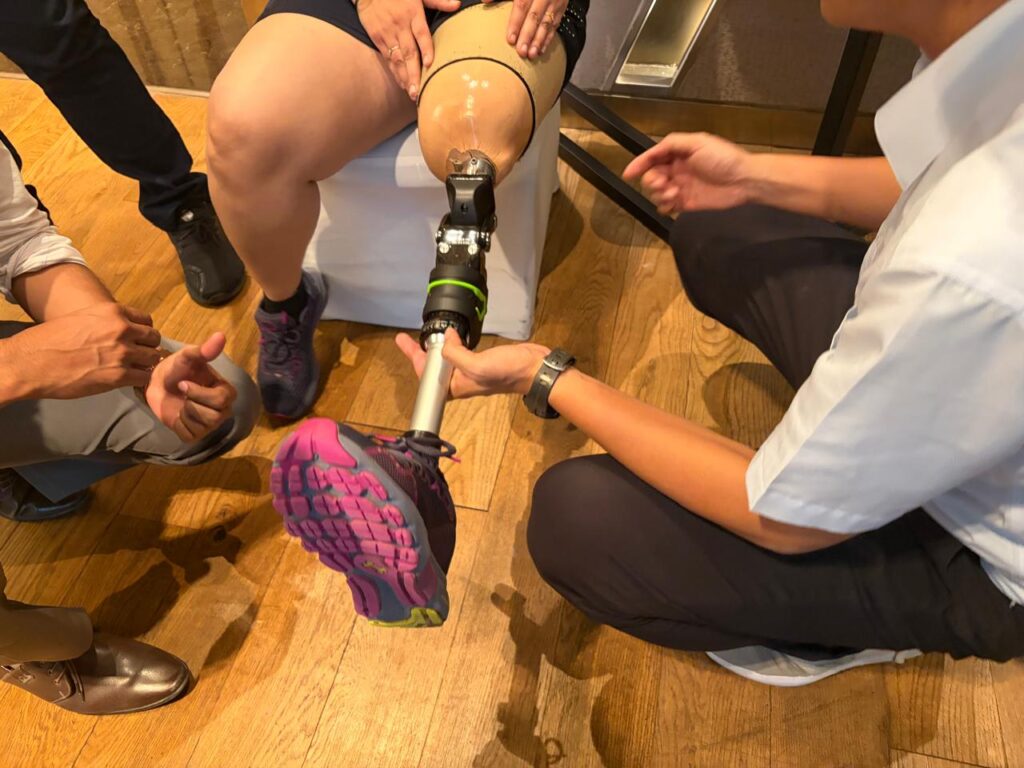
Sandeep Kaur is trying a microprocessor-controlled pneumatic knee joint for the first time.
Empowering Amputees Can Boost the Economy
Beniwal believes that if specially-abled people are rehabilitated effectively and enabled to become part of the mainstream population and workforce, they can become valuable contributors to the economy, particularly young people.
“Many times, we look at the total cost, but we don’t look at the revenue loss from the government’s perspective. If these people are rehabilitated well, they will be earning and paying taxes, contributing to the government’s revenue,” he said.
Sandeep believes that if patients have access to advanced prostheses, the country can produce more athletes and Paralympians.
“Every person has the willpower to achieve something, and if the government supports them, a lot of good things can come out of it,” she said.
Only 30% of Prosthetics are Indigenous
Dr. Dash said India has made greater progress in orthotics but still has some way to go in prosthetics, particularly in developing quality components that fully meet patients’ needs.
“Nowadays, amputees are not simply looking to walk, work in an office or perform household activities. They are increasingly participating in sports and para-athletic activities. However, we have not yet developed enough specialised prosthetic components to meet the needs of patients at these activity levels,” he said.
According to him, prosthetic components are being developed in the country by the Artificial Limbs Manufacturing Corporation of India (ALIMCO) in Kanpur, Andhra Pradesh MedTech Zone (AMTZ) in Visakhapatnam, and three private institutes.
“If we compare indigenous and imported products in prosthetics, around 30% are indigenous, while 70% are imported. In the case of orthotics, the situation is almost the reverse. We are nearly 90% self-reliant, with only around 10% of orthotic products being imported,” he added.
Dr. Dash said India has made significant progress in developing functional upper-limb prostheses, with three IIT groups developing solutions comparable to global products. However, he said the country still faces challenges in lower-extremity prosthetics.
“Other countries have been developing these technologies for nearly 100 years, while India has been working in this area for only around 20 years. That is the difference,” he noted.
He expects the balance between imported and domestically manufactured prosthetic products to change significantly over the next five years.
“Within five years, I expect the situation to reverse. Around 70% of prosthetic products will be manufactured domestically, while 30% will be imported,” he said.
Beniwal is also hopeful that India would become an R&D and manufacturing hub of prosthetics and orthotics in the next five years.
“The shift is already happening. In the next five years, you will see a complete shift,” he said.
“You will have a lot of component manufacturing and perhaps more manufacturing in India because every company also wants to localise. Everybody understands that the cost of a particular prosthesis or any product can be more affordable if you manufacture it locally,” Beniwal added.
Dr. Dash urged prosthetic and orthotic users in India to use indigenous products and provide feedback to manufacturers to help improve them.
“Feedback from users can help identify shortcomings and areas for improvement. This allows companies and technologists to refine their products based on real-world experience. Feedback from users is essential to bridge the gap between manufacturers and patients’ needs,” he said.
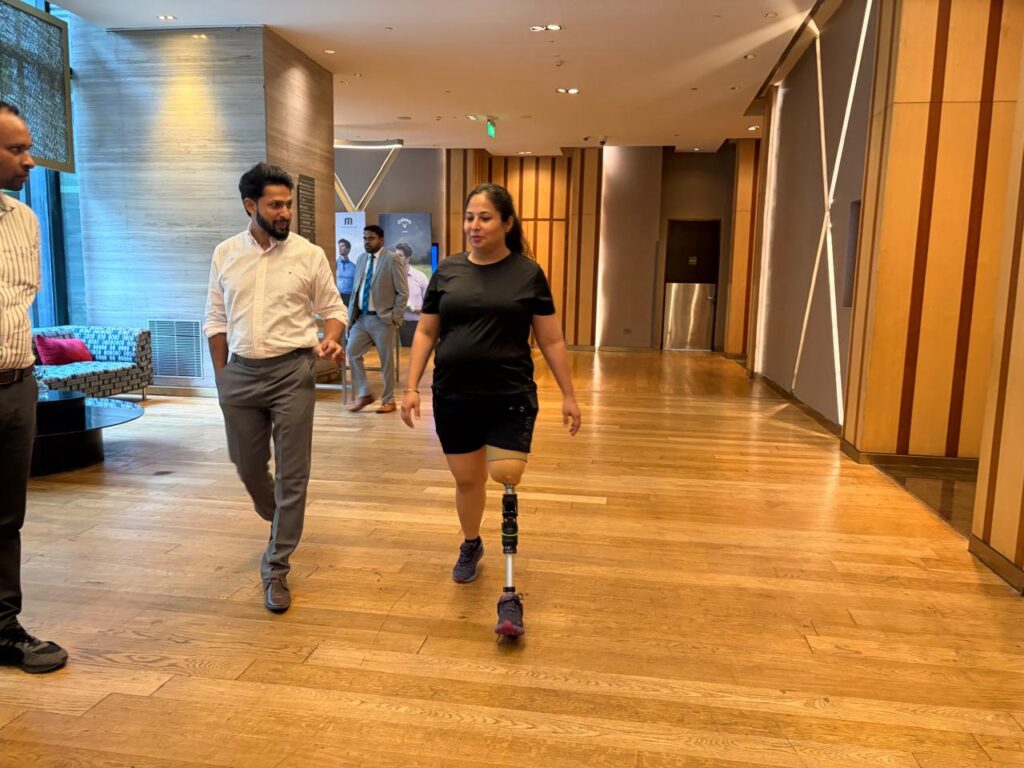
From Crutches to Marathons: Sandeep’s Journey of Resilience
Recalling her early days as an amputee, Sandeep said, “I went from being a girl who loved dancing and running to becoming dependent on crutches to walk.”
“Not only was I struggling with the pain of losing my leg, but also with the sympathy and judgment of people. The word ‘disabled’ was used for me, and people pitied me, thinking that I would be dependent on others for my whole life and that nobody would marry me. My family was very supportive, and they encouraged me to study. But it’s easy to say, but hard to face.”
Six months after losing her leg, she received a prosthetic limb.
Sandeep said, “My doctor asked me what I wanted from a prosthesis, and I said, ‘I want to dance again.’”
“I learned to walk again with the prosthetic limb. Gradually, I was able to do my daily activities, commute by buses, trains and autos like anyone else, and dance for three to four hours.”
Determined to become financially independent, Sandeep completed her studies and prepared for a government job.
“People thought it would be easy for me to get a government job because I am an amputee, but I challenged them. I applied under both the general and persons with disabilities (PwD) categories and cleared the examination in both categories,” she said proudly.
Sandeep is married and a mother of two daughters. She says her husband and in-laws have been very supportive.
At the age of 29, Sandeep started running marathons on her doctor’s advice. She now runs 10-km races using a running blade.
“That was another level of achievement. I felt free. Today, my children also run with me. People come to me and say that I have inspired them. Many patients have started going out and working after meeting me.”
Sandeep has been using her hydraulic prosthetic leg for 23 years, with periodic repairs as needed. She recently tried a microprocessor-controlled pneumatic knee joint and said she found it much lighter and more comfortable, required less effort to use, and improved her gait. However, she said her previous hydraulic prosthetic leg was also quite effective, although it was not comparable to the new one.
Sandeep has a message for other amputees: “If you lose your limb, don’t be scared. Be strong, let people judge you, have willpower, and you can do better than a normal person.”
To society, she said: “Support amputees. Don’t tell them what they can or cannot do.”
Sandeep’s story can inspire other amputees to come out of their shells and show the world what they are capable of. However, without access to advanced prosthetics, many of their dreams may remain unfulfilled.