






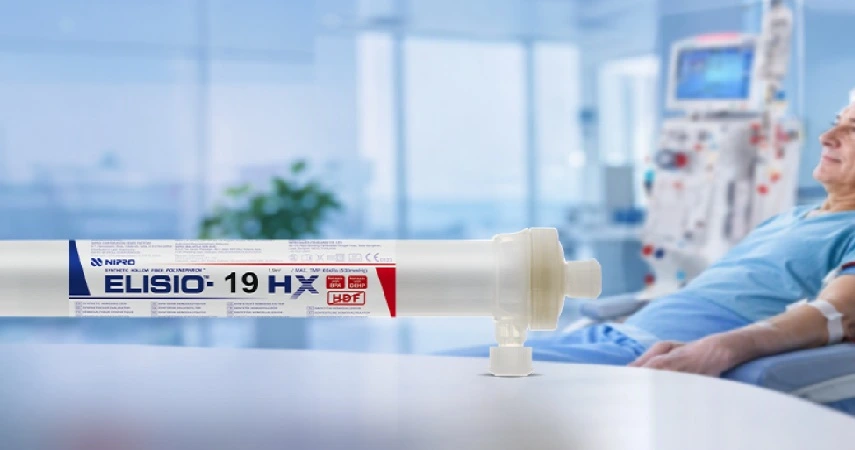
NIPRO CORPORATION has received 510(k) clearance from the US Food and Drug Administration (FDA) for its ELISIO-HX dialyzer, effective July 28, 2026. The clearance enables the company to introduce its HDs (Hemodialysis powered by super high-flux membrane) approach in the United States.
HDs is NIPRO’s expanded hemodialysis solution, designed to improve the removal of larger middle molecules linked to chronic complications of kidney disease while fitting seamlessly into existing dialysis infrastructure and established clinical workflows.
At the heart of NIPRO’s HDs approach is the ELISIO-HX dialyzer, featuring the company’s proprietary super high-flux membrane technology. The membrane features a highly controlled and precisely engineered pore structure that enhances the removal of larger middle molecules while maintaining albumin retention, helping preserve patients’ nutritional status during dialysis.
As ELISIO-HX integrates into existing hemodialysis infrastructure and established clinical workflows, healthcare providers can adopt HDs without investing in new dialysis machines or overhauling established treatment protocols.
“Innovation creates its greatest value when it becomes accessible in everyday clinical practice,” said Tsuyoshi Yamazaki, President & CEO of NIPRO CORPORATION.
“Our ambition is to broaden the number of patients who can benefit from enhanced hemodialysis. With HDs, enabled by ELISIO-HX and our proprietary super high-flux membrane technology, healthcare professionals can enhance hemodialysis using the infrastructure and expertise they already have. FDA clearance represents an important milestone in bringing this approach to patients across the United States,” he added.
The launch of HDs to the United States market builds on clinical and real-world experience with ELISIO-HX across Japan, Europe and Latin America, demonstrating its applicability across a range of healthcare settings.
Following the FDA clearance, NIPRO plans to immediately commercialize ELISIO-HX in the US. The company said it will work closely with healthcare providers to support the adoption of HDs in routine clinical practice.