



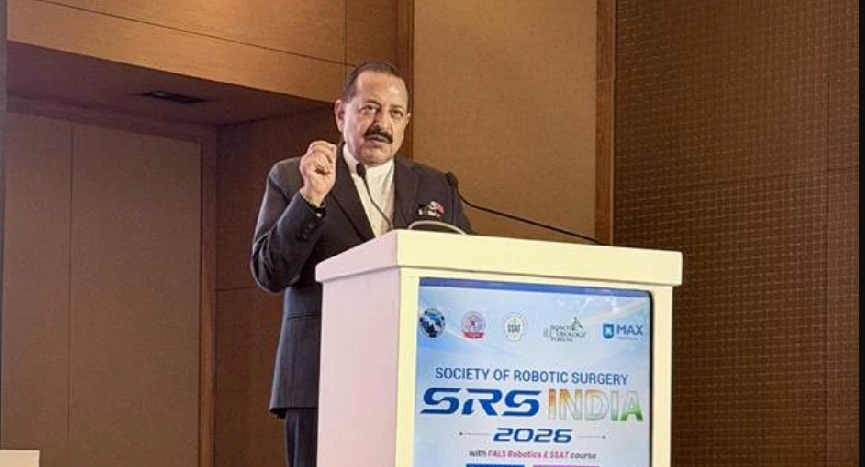
Robotics is set to become an increasingly important tool across medical specialities, extending beyond surgery to diagnostics, treatment and therapy, Union Minister of State for Science & Technology Dr Jitendra Singh said.
Delivering the inaugural address at the Society of Robotic Surgery (SRS) India 2026 Conference in New Delhi, Singh said robotics, together with Artificial Intelligence (AI) and nanoscience, would create a larger ecosystem for precision health delivery and precision medicine.
The SRS India 2026 Conference is being held at Le Méridien, New Delhi, from October 2–4, bringing together robotic surgeons, clinicians, researchers, technology innovators and healthcare professionals from India and overseas to discuss developments in robotic surgery and the future of technology-enabled healthcare.
Singh, who is also a physician and diabetologist, said robotics should not be viewed as a technology restricted to surgical procedures but as a tool that could find applications across different branches of medicine.
“It’s a tool. It will happen everywhere,” he said, adding that while the current focus is on robotic surgery, future applications could include robotic medicine, robotic endocrinology and robotic cardiology, similar to the expanding use of AI across medical specialities.
Robotics, AI to support precision medicine
Singh said medicine is entering an exciting phase of frontier practices, with the 21st century witnessing the emergence of AI, biotechnology, nuclear medicine and other technology-driven solutions.
He said the next phase would see greater application of genetically driven diagnostic solutions, alongside advances in quantum technologies, nanomedicine and robotics.
Singh said precision medicine would increasingly require treatment approaches tailored to individual patients, even when they are diagnosed with the same disease. He added that genetic profile, environmental conditions, lifestyle and dietary patterns would increasingly shape medical decision-making, making technology-enabled and personalised healthcare an important part of the future of medicine.
Referring to the Genome India Programme, Singh said genetic sequencing had already been completed for 10,000 individuals and expressed the possibility of eventually moving towards gene sequencing for every newborn.
He said undertaking such detailed genetic sequencing for a population of 1.4 billion would require the optimal use of AI and robotics.
Technology and India’s changing disease profile
Singh also pointed to India’s changing disease landscape, where infectious diseases continue to coexist with metabolic and lifestyle-related disorders. Conditions traditionally associated with older age groups are increasingly being observed among younger populations, he said, creating a complex healthcare environment.
Against this backdrop, Singh emphasised the need for a more integrated and holistic approach along with advanced technological tools.
Singh said the scale and diversity of India’s healthcare requirements make the adoption of new technologies particularly important. AI and robotics, he noted, could serve as powerful facilitatory tools for health delivery across the country, while also supporting the transition towards precision and personalised medicine.
The Minister also congratulated the organisers of SRS India 2026 for bringing robotic surgery into the domain of institutional learning, academics and professional conference platforms.
He reiterated that the adoption of emerging technologies such as robotics would be essential to keep pace with the rapidly evolving landscape of medical science.