



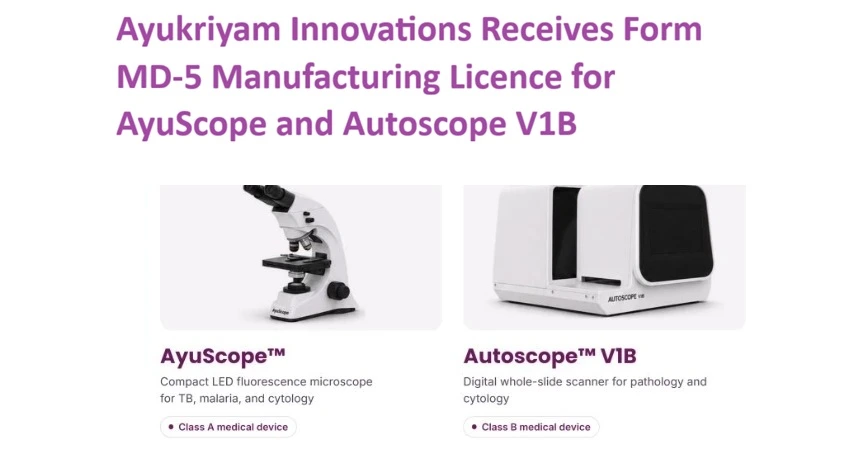
Ayukriyam Innovations, a deep-tech spin-off from the Molecular Imaging & Diagnostics Lab (MiMD) at IIT Delhi, has received a Form MD-5 manufacturing licence for its AyuScope and Autoscope V1B diagnostic instruments. The licence authorises the company to manufacture and sell both devices in India under the Medical Devices Rules, 2017.
Form MD-5 is a manufacturing licence issued by the State Licensing Authority (SLA) for Class A and Class B medical devices, including in-vitro diagnostic (IVD) devices. Manufacturers seeking the licence must apply through the Central Drugs Standard Control Organisation’s (CDSCO) SUGAM portal using Form MD-3.
Developed at the MiMD lab at IIT Delhi, the two devices aim to make diagnostic microscopy more affordable and accessible.
AyuScope is a compact LED fluorescence microscope designed for applications in tuberculosis (TB), malaria and cytology diagnosis. It is classified as a Class A medical device.
Autoscope V1B, a Class B medical device, is a digital whole-slide scanner that enables pathologists to examine glass slides as digital images.
According to the company, the license was issued on 20 November 2026.
Announcing the development on LinkedIn, the company acknowledged the support of the Indian Council of Medical Research (ICMR), the Department of Science and Technology (DST), the Technology Development Board (TDB), and IIT Delhi in bringing the two devices to this stage.
It also expressed gratitude to its investors and clinical and research partners for their continued support and feedback during the development process, adding that it looks forward to bringing the IIT Delhi-developed, Indian-made instruments to diagnostic laboratories.
Ayukriyam Innovations focuses on healthcare diagnostic technologies, including AI-assisted disease diagnosis and automation to improve diagnostic workflows.
Led by Prof. Dr Ravikrishnan Elangovan, the innovation team is also working on automated sample slide preparation platforms and cartridge-based point-of-care solutions. Its areas of focus include molecular assays, antimicrobial resistance (AMR) detection and the integration of molecular diagnostics with automation and AI to develop diagnostic solutions.