




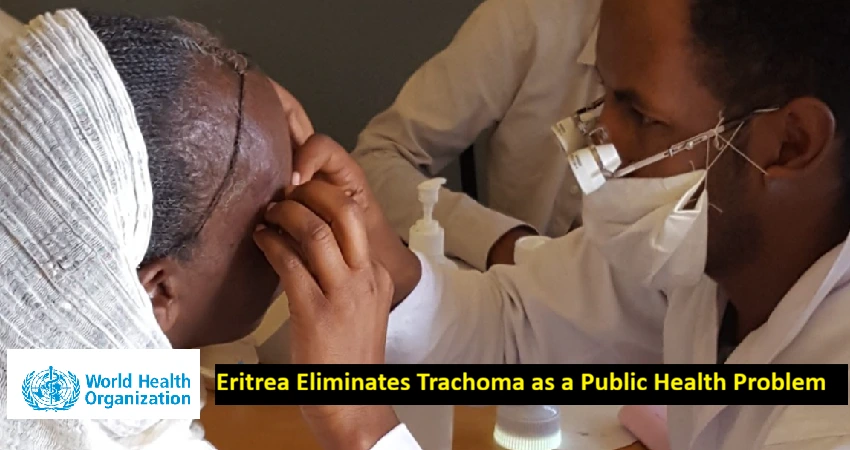
Photo: A woman being examined for trachomatous trichiasis. Credit: Ministry of Health, Eritrea
The World Health Organization (WHO) has validated Eritrea’s elimination of trachoma as a public health problem, following more than two decades of sustained efforts.
Eritrea becomes the 11th country in the WHO African Region and the 34th globally to achieve this milestone.
Trachoma, caused by the bacterium Chlamydia trachomatis, is the world’s leading infectious cause of blindness. It spreads through contact with the eye and nasal discharge of infected individuals.
Repeated infections can cause scarring of the inner eyelid, leading to a condition known as trachomatous trichiasis, in which the eyelashes turn inward. If left untreated, this can result in permanent blindness.
According to WHO, the disease is closely associated with poverty and inadequate access to essential services, including clean water, sanitation, hygiene and healthcare. It continues to affect some of the world’s most vulnerable communities.
WHO Director-General Dr Tedros Adhanom Ghebreyesus congratulated the Government and people of Eritrea on this historic achievement.
“After two decades of determined effort, Eritrea has consigned trachoma as a public health problem to history. This is a victory for the communities most affected by this devastating disease, and a powerful example of what sustained national commitment can achieve,” he said.
Eritrea’s two-decade effort to eliminate trachoma
In Eritrea, many people live in remote rural communities where access to healthcare, clean water and sanitation is limited, creating conditions that facilitate the transmission of trachoma.
Following baseline surveys conducted across different parts of the country between 2006 and 2020, Eritrea progressively implemented WHO’s recommended SAFE strategy in communities requiring intervention.
The SAFE strategy comprises four key interventions: surgery for trachomatous trichiasis, antibiotics to clear infection, facial cleanliness to reduce transmission, and environmental improvements, particularly better access to water and sanitation.
Eritrea’s elimination programme adopted a community-led sanitation approach, which contributed to significant public health gains despite limited external funding. Health workers also used digital tools for data collection and mapping to identify affected communities and direct resources to areas requiring intervention, including hard-to-reach locations.
The country surveyed all 58 sub-zobas (second-level administrative areas) and expanded interventions wherever trachoma was endemic.
The programme distributed predominantly oral azithromycin, donated by Pfizer through the International Trachoma Initiative.
Eritrea has also established systems to identify and manage new cases of trachomatous trichiasis and will continue surveillance following WHO validation.
“The elimination of trachoma as a public health problem is the result of strong national leadership and ownership, and collaboration between communities, the Ministry of Health, the Fred Hollow’s Foundation, development partners and health workers across the country,” said Dr Mary Stephen, WHO Representative to Eritrea.
Trachoma remains a public health problem in 29 countries
According to the latest WHO data, the global population requiring interventions against trachoma declined from an estimated 1.5 billion in 2002 to fewer than 100 million by November 2025, representing a reduction of approximately 94%.
However, as of March 2026, an estimated 92 million people continued to live in trachoma-endemic areas and remained at risk of blindness. The disease remained a public health problem in at least part of 29 countries.
In 2025, 98,829 people underwent surgery for the advanced stage of the disease, while 47.4 million received antibiotics.
Trachoma is among the 21 diseases and disease groups covered by WHO’s Roadmap for Neglected Tropical Diseases (NTDs) 2021–2030. NTDs affect more than one billion people, particularly those living in poverty and in remote or fragile settings with limited access to essential health services.
Endorsed by the World Health Assembly in 2020, the roadmap establishes global targets for the prevention, control, elimination and eradication of neglected tropical diseases.
With this achievement, Eritrea has also become the 66th country globally and the 23rd in the WHO African Region to eliminate at least one neglected tropical disease.