



Indian surgeons have achieved a milestone in robotic cardiac surgery by successfully performing a dual-console, five-arm robotic Totally Endoscopic Coronary Artery Bypass (TECAB) procedure on a beating heart using a Made-in-India surgical robotic system.
Claimed to be the world’s first dual-console robotic beating-heart TECAB surgery, the procedure was performed at Medanta, Gurugram, using the SSI Mantra Surgical Robotic System developed by SS Innovations.
Dr Nitin Kumar Rajput, Associate Director of Robotic and Minimally Invasive Cardiac Surgery at Medanta, Gurugram, and Dr Lalit Malik, Chief Cardiac Surgeon at Manipal Hospital, Jaipur, performed the surgery under the supervision of Dr Sudhir Srivastava, Founder, Chairman and CEO of SS Innovations International.
The surgeons operated in synchronisation using all five robotic arms of the SSI Mantra Surgical Robotic System, deployed simultaneously in a dual-console configuration. A heart stabilisation system helped steady the target area while the heart continued to beat, allowing the surgeons to perform the bypass without stopping the heart.
Addressing a press conference on Wednesday, Dr Srivastava said the patient recovered well following surgery, with blood-flow measurements through the bypass graft showing phenomenal results. A CT angiogram performed before discharge also confirmed that the graft was functioning well. The patient, who travelled from another state, was discharged successfully.
He added that while some patients can go home the day after bypass surgery, hospital stays in India may be extended by an additional day depending on travel distances and home conditions. Referring to his experience in the US, he said around 20% of his bypass patients were discharged the day after surgery.
Dr Srivastava also revealed that two more procedures have since been performed—one by Dr Malik in Jaipur and another at Medanta. All three procedures were successful, with no complications reported.
Dual-Console Robotic Beating-Heart TECAB Surgery: How it Works
TECAB is an advanced form of coronary artery bypass surgery performed through small incisions without opening the chest, unlike conventional open-heart surgery, which typically involves a sternotomy.
In conventional cardiac surgery, one surgeon may need to assist the primary surgeon by operating retractors or mobilising tissues to maintain a clear surgical view. The dual-console robotic configuration allows two surgeons to operate in coordination, while the five-arm setup provides greater flexibility in controlling multiple surgical instruments simultaneously. This arrangement supports precise movements and coordination during complex surgical steps, improving overall clinical outcomes and benefiting both the surgeon and the patient.
According to the surgical team, the patient’s recovery progress over the 15 days following surgery was encouraging.
Dr Naresh Trehan, Chairman and Managing Director of Medanta, said the successful completion of this procedure demonstrates how robotic surgery can make advanced cardiac interventions less invasive for patients.
Dr Srivastava, widely regarded as the ‘Father of Robotic Surgery in India’, said the historic procedure demonstrates the capabilities of the SSI Mantra Surgical Robotic System in enabling advanced minimally invasive cardiac surgery. He added that the successful use of dual-console control and five robotic arms in a beating-heart TECAB procedure marks a significant milestone for Indian innovation in surgical robotics.
Dr Rajput said performing such a complex procedure required precision, coordination and close collaboration between the surgeons, and the dual-console arrangement enabled them to work in synchronisation throughout the operation. He added that the patient’s recovery was encouraging and highlighted the potential of minimally invasive techniques in advancing cardiac care.
Dr Malik said the dual-console setup enabled coordinated control between the two surgeons, while the five-arm configuration supported the technical demands of the operation. He added that such advancements could expand the possibilities of minimally invasive cardiac procedures and improve the overall surgical experience for patients.
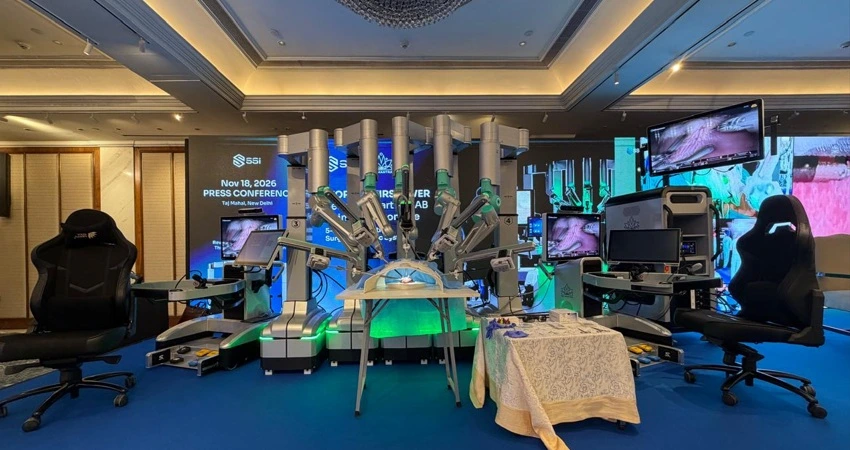
Dr Srivastava and Dr Rajput demonstrated the dual-console, five-arm SSI Mantra Surgical Robotic System, showcasing how two surgeons can operate together using separate control consoles.
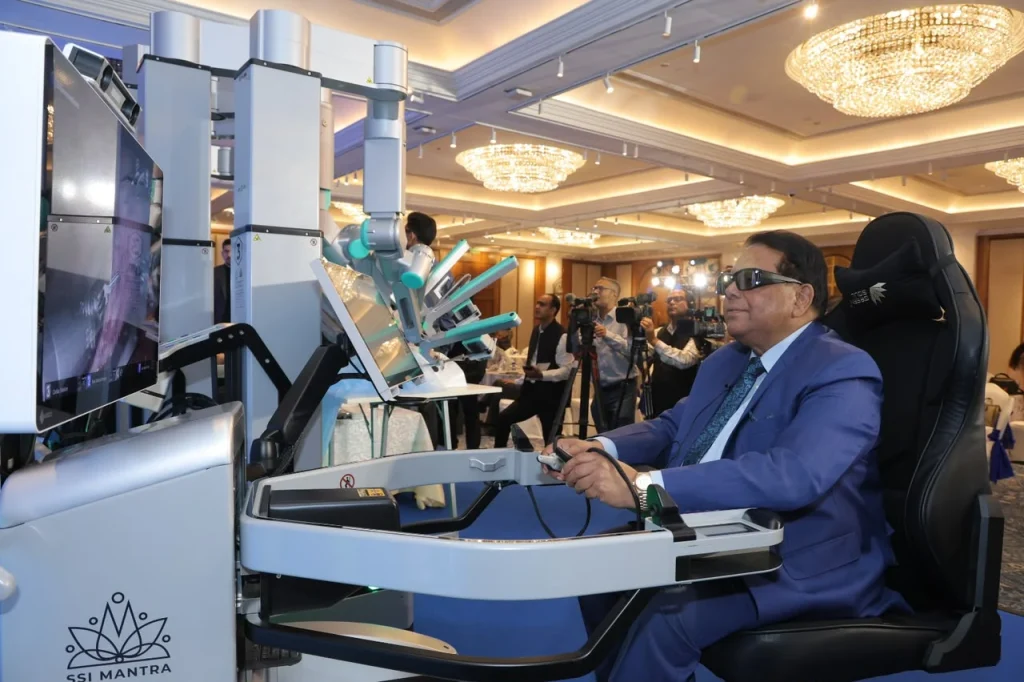
Photo: Dr Sudhir Srivastava operating one of the dual consoles of the SSI Mantra Surgical Robotic System.
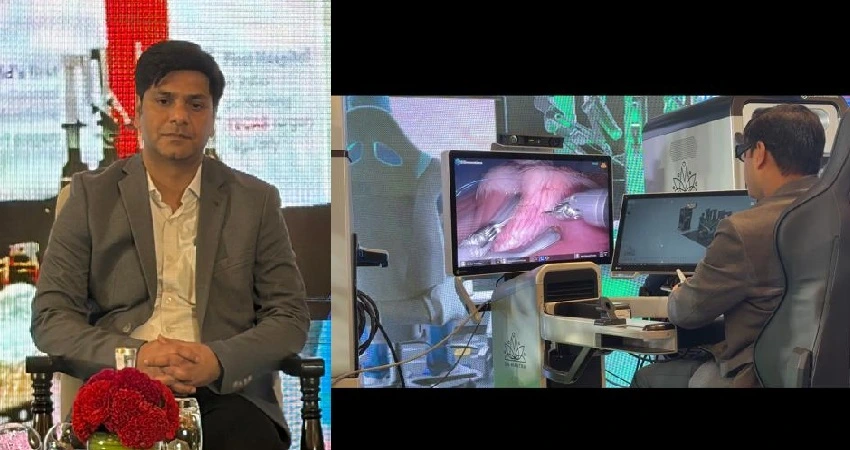
Photo: Dr Nitin Kumar Rajput operating the other console of the SSI Mantra Surgical Robotic System.
SSI Mantra Surgical Robotic System
Developed in India by SS Innovations, the SSI Mantra is a modular, multi-arm surgical robotic system designed for use across multiple surgical specialties, including cardiac surgery.
The system supports the use of three to five robotic arms and features an open-faced, ergonomic Surgeon Command Centre equipped with a 32-inch 3D 4K monitor. It also includes a 23-inch 2D touchscreen monitor for displaying patient-related information and a virtual, real-time representation of the robotic Patient Side Arm Carts.
The system supports the superimposition of 3D models generated from diagnostic imaging, while its Vision Cart provides the table-side team with the same magnified 3D 4K view available to the surgeon.
Its modular robotic arms offer flexibility in positioning and configuration, helping surgeons adapt the system to different surgical requirements. SS Innovations also offers more than 40 types of robotic endosurgical instruments for procedures across various specialties.
Surgeons Respond to Questions from the Media
Q. Is it difficult to convince patients to undergo such complex robotic bypass surgery?
Dr Malik: It is not difficult to convince patients because they can see the outcomes of others who have undergone similar procedures. Hearing about their experiences and seeing their recovery helps build confidence and encourages them to opt for robotic surgery.
The SSI’s dual-console technique is a game changer for cardiac surgery. It not only supports faster patient recovery but also saves surgeons’ time, enabling them to perform more surgeries in a day.
Q. How much time does open surgery, single-console robotic surgery and dual-console robotic surgery take? Also, do the two surgeons operating from separate consoles need to be in the same location, or can they operate from different locations?
Dr Malik: Open bypass surgery generally takes around four to five hours. When we started performing robotic procedures using a single console, the operating time came down to approximately two to three hours. In some of our more recent cases using a single console, we have been able to reduce the time to around one hour.
Both surgeons currently operate from consoles located in the same place. Although the SSI Mantra system has telesurgery capabilities, we are not exploring remote dual-console operations at this stage.
Dr Srivastava added thatthe team is taking a cautious approach as it begins exploring the technology, ensuring that every procedure is performed safely and successfully. However, he expects remote collaboration between surgeons to become possible very soon.
Q. How many SSI Mantra robotic systems have been installed worldwide? How many of these are installed in government hospitals in India?
Dr Srivastava: So far, 250 SSI Mantra robotic systems have been installed worldwide, including 230 in India and 20 in other countries. Of the installations in India, approximately 15–16 are in government institutions and medical colleges. Our systems are also installed in several major healthcare institutions across the country.
Q. How cost-competitive is the SSI Mantra system compared with other advanced surgical robotic systems?
Dr Srivastava: Our system costs approximately one-third as much as competing technologies. Our goal was to make robotic surgery more cost-effective for patients without compromising on quality. We believe we have achieved that objective, making the technology more accessible to a larger population.