



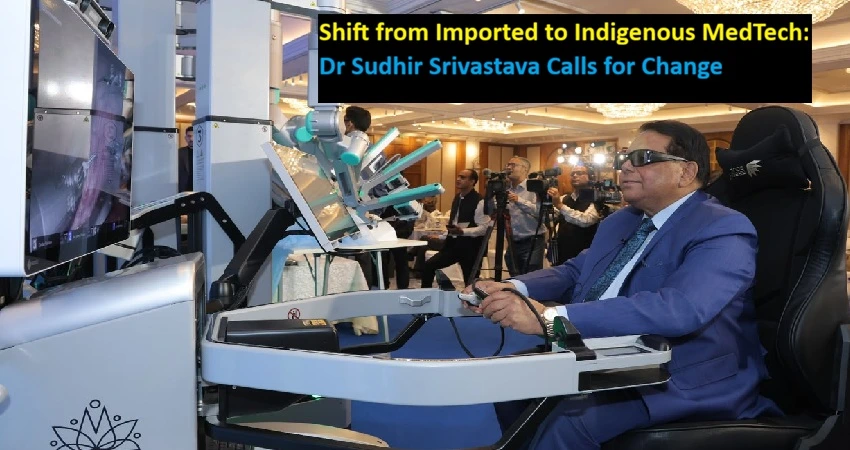
The Indian medtech industry is witnessing encouraging developments, even as the country remains heavily dependent on imported medical equipment. Dr Sudhir Srivastava, founder, chairman and CEO of SS Innovations International, has called for a shift away from the ‘anything foreign is better than local’ mindset, urging the government and healthcare institutions to prioritise homegrown medical technology.
His remarks come as India has achieved a global milestone in robotic cardiac surgery. A dual-console, five-arm robotic beating-heart Totally Endoscopic Coronary Artery Bypass (TECAB) procedure was successfully performed at Medanta, Gurugram, using the indigenously developed SSI Mantra Surgical Robotic System.
Described as the world’s first procedure of its kind, the surgery was performed by Dr Nitin Kumar Rajput, Associate Director of Robotic and Minimally Invasive Cardiac Surgery at Medanta, Gurugram, and Dr Lalit Malik, Chief Cardiac Surgeon at Manipal Hospital, Jaipur, under the supervision of Dr Sudhir Srivastava.
Following this historic surgery, two more procedures have since been performed—one by Dr Malik in Jaipur and another at Medanta. All three procedures were successful, with no complications reported, he said.
According to Dr Srivastava, the achievement demonstrates the capabilities of the SSI Mantra Surgical Robotic System in enabling advanced minimally invasive cardiac surgery and marks a significant milestone for India’s indigenous surgical robotics industry.
In an exclusive interaction with Health Xplore India, Dr Srivastava highlighted the importance of promoting indigenous medical devices and reducing dependence on imported systems.
He stressed the need to move away from the ‘anything foreign is better than local’ mindset, urging the government and healthcare institutions to prioritise homegrown medical technology. He also asserted that the SSI Mantra outperforms competing imported systems in terms of technology, quality and cost-effectiveness.
“Remain open-minded. Throw away the bias and the back-channel peddling that occurs in various government hospitals. Be proud that we already have a system that is better than imported alternatives, not only in terms of technology and quality but also cost,” he said, urging healthcare institutions to support indigenous medical technology.
He also called for stricter restrictions on refurbished imported robotic systems and questioned the continued spending of public funds on foreign technologies when comparable or better indigenous alternatives are available.
Emphasising the government’s Make in India, Aatmanirbhar Bharat and Viksit Bharat initiatives, he said promoting homegrown medical technology was essential to achieving these national goals and ensuring that public money benefits the domestic industry.
‘Virtually All Surgical Procedures Will Eventually Be Robotic-Assisted’: Dr Nitin Kumar Rajput
Dr Rajput said robotic surgery represents the future of surgical care, predicting that virtually all surgical procedures will eventually be performed with robotic assistance.
“The future lies in robotic surgery. Of course, human involvement will remain essential, and surgeons will continue to operate these systems in the foreseeable future. However, virtually all surgical procedures will eventually transition to robotic-assisted surgery,” he said.
Dr Rajput identified three key factors that could accelerate the adoption of robotic surgery across India: affordability, awareness and supportive healthcare policies.
He noted that the indigenously developed SSI Mantra is significantly more affordable than competing systems, with hospitals in Tier II and Tier III cities already adopting the technology.
He also highlighted the need to raise awareness about the availability of robotic surgery and extend insurance coverage to robotic procedures.
“Still, many insurance companies are not providing support for robotic surgical procedures,” Dr Rajput pointed out.
Additionally, he called for government healthcare schemes to include minimally invasive and robotic surgeries in their procedure code lists so that more patients can benefit from these technologies.
Citing the SSI Mantra system’s low operating costs, he expressed confidence that more hospitals in smaller cities would adopt the technology.
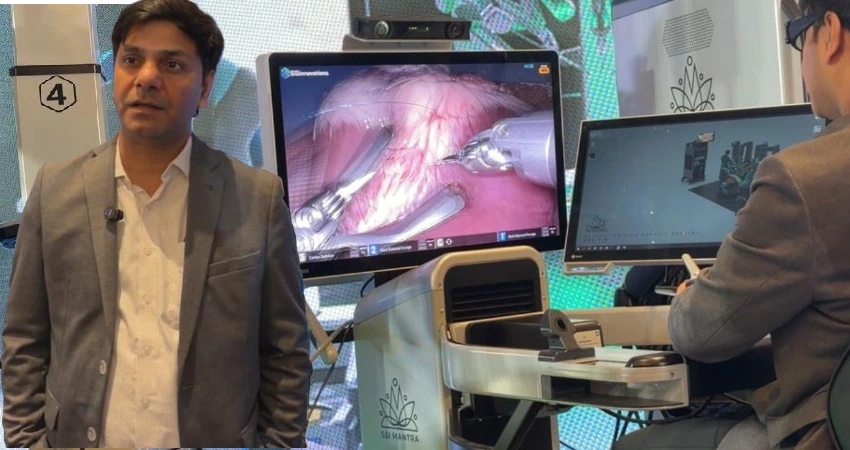
Photo: Dr Nitin Kumar Rajput, Associate Director of Robotic and Minimally Invasive Cardiac Surgery at Medanta, Gurugram.
Open-heart Surgery vs Robotic-assisted Surgery: Understanding the Cost Difference
Dr Rajput explained that robotic-assisted surgery involves an additional cost compared with conventional open-heart surgery. However, he said the additional expense needs to be considered alongside the potential benefits, including faster recovery and smaller surgical incisions.
Citing an illustrative example, he said that if conventional open-heart surgery costs around INR 4 lakh, using the SSI Mantra Surgical Robotic System with three robotic instruments would add approximately INR 80,000. Using five instruments would increase the additional cost to around INR 1.25–1.35 lakh.
Dr Rajput said patients are increasingly receptive to robotic-assisted minimally invasive surgery when they are informed about the available treatment options, associated costs and potential benefits.
“A patient may be advised to undergo bypass surgery as the first treatment option, with stenting as the second. If I tell the patient that I will perform conventional open-heart surgery, which involves a large incision in the chest, they may prefer the second option instead.
“However, if I explain that we can perform the surgery using a robotic system without a large chest incision, and it may cost you 1.5 lakh rupees more, most patients tend to opt for minimally invasive robotic surgery,” he said.
According to him, this also offers a psychological advantage, as patients are more willing to undergo surgery, experience lower stress and may recover faster after the procedure.
Robotic Surgery Does Not Mean Surgeons Are Out of the Picture
Addressing misconceptions among patients who may be reluctant to opt for robotic surgery, Dr Rajput clarified that surgical robots do not operate independently.
“Whenever we say ‘robot’, everyone thinks of a human-like robot. However, a medical robot is not a human-like machine, nor does it operate on its own. The robot is essentially an instrument controlled by the surgeon. The surgeon performs the operation, while the robot replicates the surgeon’s hand movements.
“Essentially, the robotic system is an advanced surgical instrument that assists the surgeon and facilitates minimally invasive procedures without the need for a large chest incision. That is the advantage of robotic surgery. The surgeon is always in control,” he said.
The achievement underscores India’s growing capabilities in advanced medical technology and indigenous surgical robotics. However, as Dr Srivastava and Dr Rajput pointed out, greater awareness of robotic surgery, supportive healthcare policies and wider adoption of Made-in-India surgical technologies will be essential to expanding patient access and reducing dependence on imported equipment.
Here’s the exclusive interview with Dr Sudhir Srivastava …
Watch the interview with Dr Nitin Kumar Rajput here…