



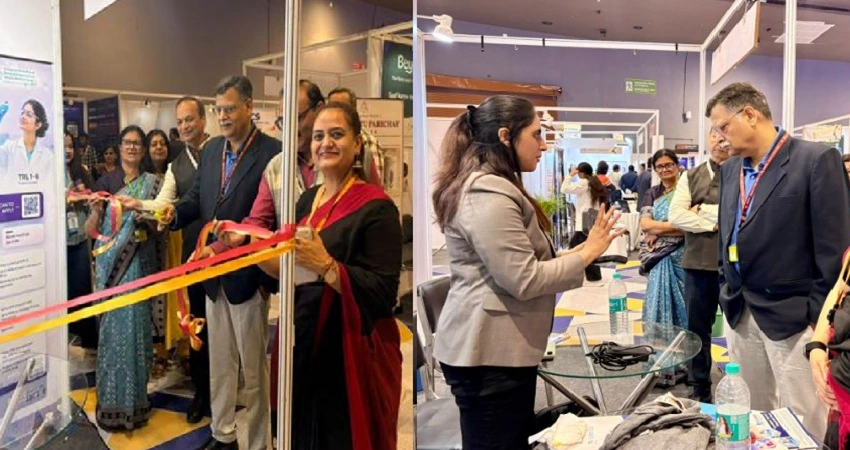
The Department of Pharmaceuticals (DoP) is showcasing indigenous pharmaceutical and medical technology innovations from 10 startups at the 45th India International Trade Fair (IITF) 2026, being held at Bharat Mandapam, New Delhi.
The Department, in collaboration with the Department for Promotion of Industry and Internal Trade (DPIIT), has sponsored stalls in the ‘Hall of Inspiration’ from 19 to 23 November 2026, providing emerging startups with a platform to showcase their products, prototypes, technologies and innovative solutions.
Awadhesh Kumar Chaudhary, Senior Economic Advisor, Department of Pharmaceuticals, inaugurated the stalls on 19 November in the presence of senior officials and employees of the Department.
The participating startups are supported under the Scheme for Promotion of Research and Innovation in Pharma-MedTech (PRIP), which aims to strengthen India’s research, product development and indigenous technology capabilities in the pharmaceutical and medical technology sectors.
The innovations on display span diagnostics, medical devices, advanced therapies, drug development and regenerative medicine. These include:
- AI-powered microscopes, automated diagnostic machines and indigenous molecular kits for detecting tuberculosis (TB), COVID-19 and other infections.
- Affordable AI-enabled bionic ear implants and hearing rehabilitation devices.
- Protective surgical helmets designed for doctors performing complex procedures such as hip and knee replacements.
- Advanced vaccine and biological drug development technologies, including 3D tumour models to assess chemotherapy effectiveness.
- Implantable bone-lengthening devices for limb reconstruction, CAR-T cell therapy for blood cancers and gene therapy for inherited blood disorders.
- AI-designed oral medicines under development for obesity and diabetes.
- Regenerative medicine technologies to repair damaged tissues and treat eye, liver and lung diseases.
- Portable blood-testing machines capable of delivering blood count results in just 10 minutes.
The initiative is part of the department’s continued efforts to promote indigenous innovation, strengthen the capabilities of Indian pharmaceutical and medtech startups, and build a competitive, innovation-driven pharmaceutical and medical technology ecosystem in the country.
Pharma-MedTech Sector PRIP scheme
The Scheme for Promotion of Research and Innovation in Pharma-MedTech Sector (PRIP) was launched by the Department of Pharmaceuticals to position India as a global hub for research and development (R&D) in the pharmaceutical and medical technology sectors.
The scheme has a total financial outlay of INR 5,000 crore, comprising INR 700 crore for establishing Centres of Excellence (CoEs) at seven National Institutes of Pharmaceutical Education and Research (NIPERs) and INR 4,200 crore to strengthen the R&D ecosystem and accelerate investments in the sector.
The scheme is expected to catalyse the Pharma-MedTech innovation pipeline by supporting around 300 projects and attracting total R&D investments of approximately INR 11,000 crore in areas such as new medicines, complex generics, biosimilars and innovative medical devices.
Under the scheme, financial assistance is available for both early-stage and later-stage projects.
For early-stage projects, MSMEs and startups can seek assistance for projects costing up to INR 9 crore, with financial support of up to INR 5 crore. The assistance covers 100% of the project cost up to INR 1 crore and 50% of the additional cost beyond INR 1 crore, subject to the maximum assistance limit of INR 5 crore.
For later-stage projects, industry players, MSMEs and startups can apply for projects costing up to INR 285 crore, with financial assistance covering 35% of the project cost, subject to a maximum of INR 100 crore.
Additionally, the scheme provides enhanced financial support for later-stage projects in Strategic Priority Innovation (SPI) areas. These areas have high public health significance but relatively lower market potential, making them critical to strengthening India’s health security framework.
For projects falling under the identified SPI areas, financial assistance may cover up to 50% of the project cost, subject to a maximum of INR 100 crore. These priority areas include specified rare diseases, antimicrobial resistance (AMR), vaccine-preventable diseases, tropical vector-borne diseases, and pathogens with the potential to cause outbreaks or pandemics.