






Researchers at Pusan National University, Korea, have developed a stretchable organic electrochemical transistor (OECT) that can be easily reprogrammed to serve different purposes, marking a significant step forward for wearable healthcare technologies.
Wearable electronics are becoming more sophisticated, moving beyond basic sensing to systems capable of processing information and supporting real-time medical monitoring. However, most current wearable devices require multiple electronic components to handle sensing, computation and data storage, resulting in bulkier designs, higher power consumption, increased manufacturing costs, and reduced suitability for daily use.
To address this challenge, a research team led by Assistant Professor Hyunseok Shim at Pusan National University developed a stretchable OECT that can be reprogrammed to perform different functions simply by changing the salt concentration of its surrounding electrolyte. The study was published in ACS Nano after first appearing online on June 24, 2026.
The researchers explained that the soft electronic device operates by moving ions through a conducting polymer and can be reversibly switched from a logic circuit for digital computations to an analogue “artificial synapse” by altering the salt concentration of its surrounding electrolyte.
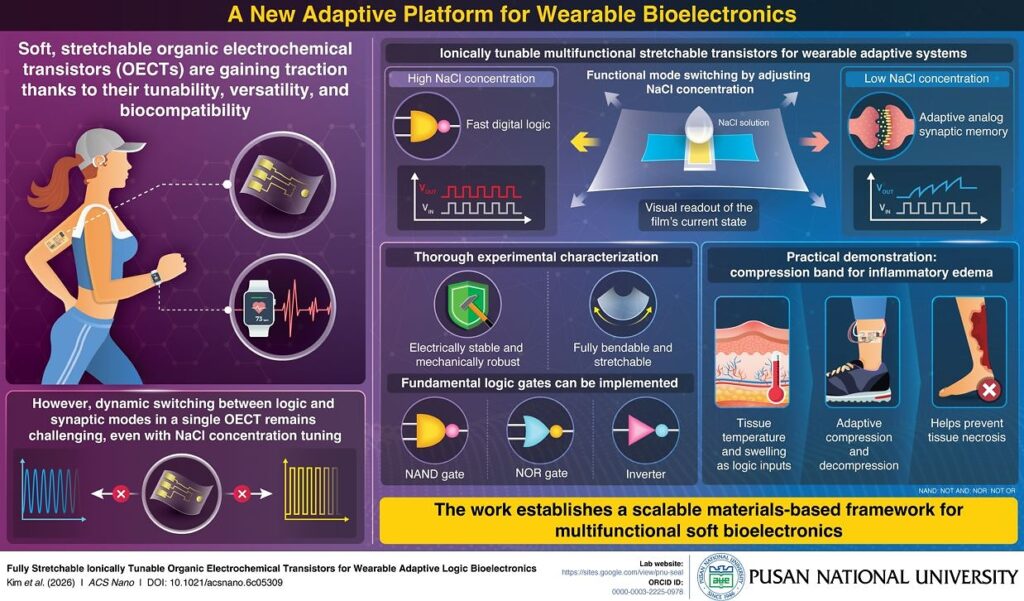
Rather than creating an entirely new material, the team modified the conducting polymer PEDOT:PSS with two additives that improved both the electrical conductivity of the OECT and its ability to repeatedly stretch without degrading.
The key innovation was that changing the concentration of sodium chloride in the electrolyte altered how ions moved through the transistor, making it possible to switch between operating modes. High salt concentrations enabled rapid ON/OFF gating required for digital logic operations. In contrast, lower salt concentrations produced analogue, memory-like behaviour similar to the voltage profile of synapses between neurons.
A unique feature of the device is that its internal state is visible. As it switches modes, it changes colour from light blue to dark blue, allowing users to determine its operating status at a glance.
According to Dr. Shim, the technology could serve as the basis for a variety of medical and health-related wearable devices.
“The proposed platform is suitable for smart electronic skin, wearable health monitors, and soft bioelectronic implants, where a single stretchable device can both process and store physiological signals without added circuitry,” he said.
To demonstrate its potential, the researchers created a wearable patch capable of monitoring inflammatory edema and skin temperature. The system automatically adjusts the tightness of a compression band based on the user’s condition, helping reduce the risk of tissue damage.
The researchers believe the platform could eventually enable autonomous personalised therapies, including intelligent compression bandages and electronic skin that responds to injuries in real time.
Beyond healthcare, the technology is expected to contribute to future neuromorphic bioelectronics, soft robotics and adaptive prosthetic devices capable of learning from and responding to their environment.