







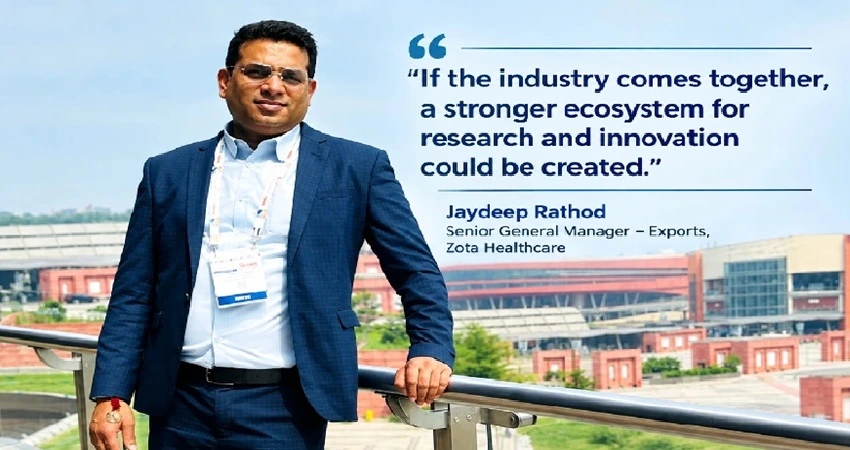
Jaydeep Rathod, Senior General Manager – Exports, Zota Healthcare
The 12th edition of iPHEX, organised by the Pharmaceuticals Export Promotion Council of India (Pharmexcil), with the support of the Department of Commerce, was held from September 7–9 at Bharat Mandapam, New Delhi. The exhibition aimed to provide a platform to further diversify export markets and connect Indian manufacturers with international buyers. Health Xplore spoke to exhibitors about their experience at the event, industry challenges and the support required to expand India’s pharmaceutical exports.
Jaydeep Rathod, Senior General Manager – Exports, Zota Healthcare, shared the company’s plans to enter new markets, evolving regulatory requirements and the challenges India faces in becoming a global hub for pharmaceutical innovation.
Q. What are you expecting from iPHEX 2026?
This is the second time we are participating in iPHEX. This is a very good platform to interact directly with international buyers. Instead of travelling to different countries and meeting clients individually, we can have several such interactions under one roof. This helps us explore multiple business opportunities, as we want to increase our reach across different countries and make our healthcare products accessible to people who need them.
Q. What are the new markets that Zota Healthcare is targeting?
We are already having discussions with potential partners and buyers from several markets. We are particularly looking at the Latin America region and are also exploring opportunities across the Commonwealth of Independent States (CIS) countries. Gulf Cooperation Council (GCC) is another region where we are studying the regulatory requirements and market opportunities.
At this exhibition, we are showcasing three patented products, and our objective is to expand their reach across different international markets.
Q. There is growing emphasis on the need for the Indian pharmaceutical industry to focus on R&D and innovation. What do you think are the key barriers preventing manufacturers from investing more in research and innovation?
Research and innovation are expensive, and not every company can afford to invest heavily in these areas, particularly at the initial stage. One way forward could be greater collaboration among companies, where resources and expertise are pooled to undertake research collectively and work for the country.
Some large pharmaceutical companies, such as Sun Pharma, Cipla and Zydus, have dedicated research facilities. If companies could come together and collaborate on research initiatives at government pharmacy colleges, it could make the process more affordable and help accelerate innovation.
At present, companies tend to focus primarily on their individual requirements. If the industry comes together, a stronger ecosystem for research and innovation could be created.
Q. Zota Healthcare has been in the export business for around four years. What challenges do smaller or relatively young companies face when expanding into international markets?
The maturity of international markets is increasing, and regulatory and documentation requirements are becoming more stringent. Our challenge is to continuously adapt to and meet these evolving requirements.
For example, markets such as Vietnam, Tanzania, Ghana and Nigeria are strengthening their regulatory requirements. Therefore, we have to ensure that our documentation, processes and products meet the required standards while continuing to build our business in these markets.
Q. What kind of government support or policy changes would help companies like Zota Healthcare expand internationally?
Greater cooperation and stronger relationships between India and international markets can help Indian pharmaceutical companies expand. At the same time, we need to continuously strengthen our own standards so that we can meet the requirements of international markets.
By 2047, India is aiming to become a developed country, and if Zota Healthcare can contribute even in a small way towards that vision, we will be happy to do our part. We will continue to explore new markets, expand our exports and work towards innovations.
Q. How long do you think India will take to emerge as a global hub for innovation?
If everyone comes together and works for the country, progress can happen much faster. Collaboration can create momentum and help us move in the right direction more quickly.
I experienced this sense of collective purpose even at this exhibition. When I stood up for the national anthem, Jana Gana Mana, I could feel how the atmosphere and emotions changed. If we can bring that same sense of commitment and collective responsibility into our work, I believe we can move 10 times faster than we are moving individually today.
Q. So, do you believe collaboration is the need of the hour, particularly in research and innovation?
Absolutely. Collaboration is especially important in research. I hope we see more of it in the coming years.
The government could also play a role by facilitating industry-led research groups or platforms where companies can come together to work on specific areas of need.