





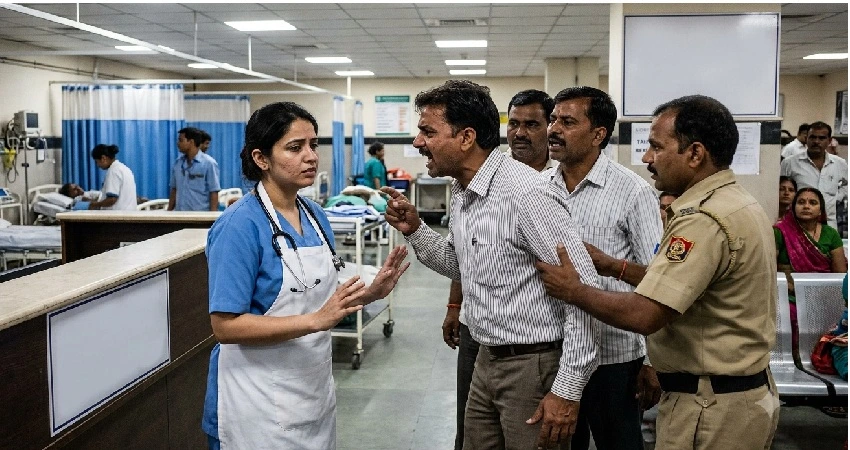
Doctors have historically been viewed as lifesavers and protectors. However, a growing number of incidents involving threats, violence and harassment against healthcare professionals have raised concerns about their safety and well-being.
The need to “protect the protectors” resonated at the recent launch of Ozone SHIELD, an initiative introduced by Ozone Pharmaceuticals to support doctors caught in such untoward situations. The initiative is intended to provide personal security support during threats or incidents of physical harassment, legal assistance in medico-legal matters, and emotional wellbeing support through counselling.
Recognising the need for such an initiative, Ozone Pharmaceuticals cited a nationwide survey conducted this year by experts from AIIMS, Safdarjung Hospital and VMMC, involving more than 1,500 healthcare workers. The survey found that 78.4% of respondents had faced threats while on duty, while 58.2% said they did not feel safe in their workplace.
Obstetricians and gynaecologists attending the event spoke about the vulnerabilities they face.
Dr Abha Majumdar, head of the IVF Department at Sir Ganga Ram Hospital, shared several cases of doctors who had faced legal challenges, threats or physical attacks in the course of their professional duties.
Sharing her own experience, Dr Majumdar recounted a case in which a patient died after 54 days in the ICU. The patient’s relatives damaged the ICU glass and filed a legal case against her. She said it took 10 years for her to be cleared.
“But for those 10 years, you have to keep appearing before different authorities. You have to go to the Medical Council, appear before the National Council and go to court. In 2015, the case was finally cleared, and it was found that there was absolutely no basis for it,” she said.
Dr Majumdar added that some people who had gone through similar experiences had subsequently left the medical profession, although she did not name them.
What’s Contributing to Rising Violence Against Doctors?
“People’s expectations from doctors have increased,” said Dr Kiran Chhabra, senior consultant gynaecologist and obstetrician and director, Chhabra Medicare Centre.
“They want more and more from doctors and sometimes expect doctors to do everything. But a doctor is not God. So many changes can happen in the human body at the same time that a doctor cannot possibly account for every change at every moment,” she added.
Dr Chhabra wants people to understand that a doctor will not intentionally try to harm or neglect a patient. “If you treat one patient well, hundreds of other patients may come to you because they hear positive things about your care. But if something goes wrong with one patient, thousands of people may hear about it. So, no doctor would ever want their patient to be harmed or have a problem.”
Dr Sanchita Dubey, senior consultant, Obstetrics and Gynaecology, Apollo Hospital Noida, echoed similar sentiments.
She said, “We as doctors work day and night to build a reputation. We earn it over years, through countless cases and our work, and then it goes away with one incident, where we are not even given a chance to explain ourselves.”
“Unfortunate incidents can happen. We are not God; we are simply people who are here to serve,” she added.
Commercialisation of Healthcare
Dr Majumdar pointed out that globalisation, along with the advent of mobile phones and the internet, has created a desire among people to become rich soon.
“Doctors are not devoid of this desire,” she said, acknowledging that certain irregularities have also occurred in medical practice.
She explained, “When they see that we have struggled for years to earn a nominal salary, while a colleague working as a CA or in another profession may be earning five times as much, it can create frustration.”
Dr Majumdar agreed that commercialisation of healthcare has led to a growing perception that doctors are extracting money from patients or unnecessarily carrying out certain procedures.
“Trust in doctors is declining,” Dr Chhabra said, noting that it is partly because people think that doctors have become commercialised.
“Commercialisation happens in every field, and doctors are no exception. If, out of 100 doctors, two to four per cent think from a commercial perspective, we cannot blame all doctors. We have to look at the issue objectively.”
“If I have been treating somebody for many years and suddenly something happens, how can that person say that I am doing something for money now?” Dr Chhabra said.
She also pointed out that doctors working in corporate hospitals do not necessarily receive a significant share of the money charged to patients.
Echoing this point, Dr Dubey added that doctors receive only around 10% of the hospital bill, while a significant portion of the revenue goes towards infrastructure, equipment, staff, technology and other operational costs.
She questioned the rationale for directing anger at doctors over hospital bills and stressed that doctors should not be targeted because of financial grievances related to healthcare costs.
Security, Legal and Emotional Support for Doctors
Dr Dubey said security concerns, legal uncertainties and emotional or psychological stress are equally significant challenges for doctors.
“First, security support is important to handle sudden aggression among people. At the same time, young doctors should be trained to remain emotionally balanced while dealing with difficult situations,” she said.
Dr Dubey also stressed the need for psychological and legal support, particularly in smaller healthcare facilities where such resources may be limited.
“We are so busy with our studies, medical dynamics and learning new things. The legal aspect is something that is often beyond our understanding. Once you get into such a situation, you then start studying and understanding the legal aspects,” she said.
Dr Majumdar said that while legal, security and emotional support are all essential, the biggest impact is on psychological well-being.
“The legal process may take time. It may eventually give us a clean chit or bring the matter to an end if we are not at fault. But the emotional trauma that we go through for years can be a major factor for us,” she said.
Dr Chhabra emphasised that psychological support for doctors usually comes from family, colleagues and seniors, who can provide both emotional support and practical guidance. But she stressed that doctors should not hesitate to seek professional psychological help when needed.
“Just as we believe in a multidisciplinary approach in our work, we should also seek appropriate support for our own emotional and psychological well-being. There should be no shame in asking for help when you need it,” she said.
Dr. Anupama Sharma, Infertility Specialist at Divy Ayurveda, highlighted the emotional impact of violence and allegations on doctors, noting that medical training requires years of hard work and dedication, yet doctors can quickly shift from being viewed as “God” to being blamed as “devils” after an adverse incident.
“It is never a doctor’s intention to harm a patient. We always think about their well-being—how to treat them well, care for them and help them heal,” she said.
What Do Doctors Expect from Society?
Dr Dubey wants people to understand that medicine is a complex field, and the human body itself is extremely complex, with different systems working together.
“Therefore, it can sometimes be difficult for doctors to arrive at a single conclusion. When a seriously ill patient comes to us, we need to conduct a battery of investigations and tests to understand the underlying pathology and plan the treatment accordingly,” she said.
Dr Chhabra highlighted the need for public awareness about the systems and processes involved in healthcare and the knowledge that medical professionals spend years acquiring.
She said, “India has a population of around 1.5 billion people, and we have worked in very small healthcare setups where facilities are limited. Yet, we have treated patients. At the same time, patients are also treated in large corporate hospitals with access to advanced equipment. We are a diverse country, and there is not one standard level of healthcare facility everywhere.”
“Doctors put their heart and soul into treating their patients. That is the truth. They make sacrifices for their patients many times. There may be a puja or a family function taking place at home, but if they receive a call saying that a patient is critically ill, the doctor leaves immediately. They work at odd hours and are often available whenever their patients need them. This is the kind of commitment doctors make to their patients,” she added.
Dr Chhabra said doctors cannot be blamed for everything, as there are many gaps in the healthcare system that need to be addressed.
She continued, “People are now leading increasingly sedentary lifestyles and consuming whatever is readily available in the market. They may go to a chemist and buy medicines without consulting a doctor.”
“So many patients are going to pharmacies and getting MTP pills for abortion without proper medical supervision. These medicines can have serious side effects and complications. Anything can happen to a patient, including severe bleeding or even death. If a patient comes to me after taking such medication and I cannot save her, how can I be blamed for what happened before she came to me?”
“If the medicine is of poor quality, how am I responsible for that? If the medicine is expensive, why should the patient blame the doctor?” Dr Chhabra said, highlighting that the government needs to address these issues.
She further emphasised that medicines should be affordable, meet appropriate quality standards, and be subject to proper regulation to ensure the required dosage and quality are maintained.
Meanwhile, Dr Majumdar urged doctors to avoid making negative comments about fellow doctors, whether on social media or when reviewing a patient’s previous treatment.
“This is one thing that will improve the image of doctors in a patient’s mind, and that can go a long way in shaping society’s perception of the medical profession,” she said.
Message for Young Doctors
Dr Chhabra advised young doctors to learn how to protect themselves professionally and legally.
“Young doctors entering clinical practice should learn how to document their findings and how to communicate properly with patients. They should explain the treatment being given, the possible complications and the risks involved, document these discussions and obtain the necessary signatures. These things are very important because proper documentation can protect doctors in legal matters.”
“However, while doing all this, doctors should not lose their human touch,” she said, adding, “The people you are treating are human beings, and you cannot treat them like a robot or a machine. To treat them, you have to be compassionate because anyone who comes to you is likely to be in pain. If you understand and share that pain with love, patients are more likely to understand you.”
She also advised young doctors to familiarise themselves with the legal system and understand their rights and responsibilities so they are better prepared to deal with legal situations.
“This is important both for their own protection and for patient safety,” she concluded.