






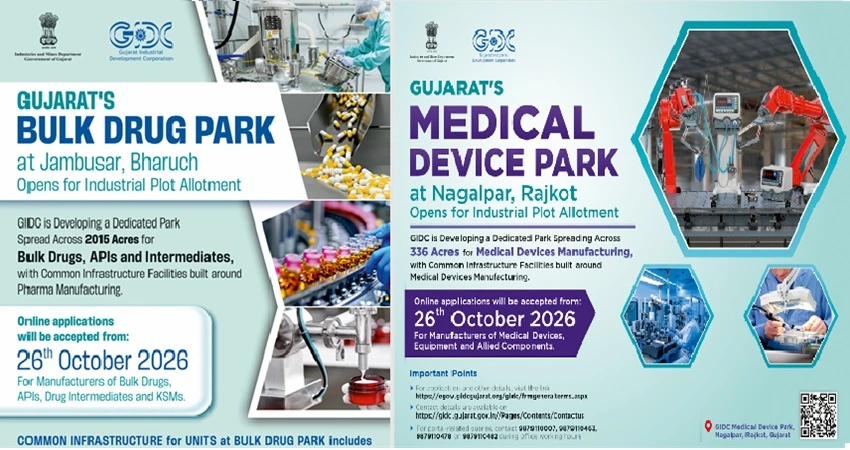
Gujarat has opened its medical device and bulk drug parks for industrial plot allotment, with online applications scheduled to be accepted from October 26 to November 25, 2026. The initiative aims to strengthen domestic manufacturing of medical devices, active pharmaceutical ingredients (APIs), drug intermediates and other pharmaceutical products.
The Gujarat Industrial Development Corporation (GIDC) is developing a 336-acre medical device park at Nagalpar in Rajkot district and a 2,015-acre bulk drug park at Jambusar in Bharuch district. Both parks are being designed with common infrastructure facilities to support manufacturing and improve operational efficiency.
The medical device park will cater to manufacturers of medical devices, equipment and allied components, while the bulk drug park will target manufacturers of APIs, bulk drugs, drug intermediates and key starting materials (KSMs).
The parks are expected to provide manufacturers with access to dedicated industrial infrastructure, helping them scale production, strengthen supply chains and improve their competitiveness in domestic and international markets.
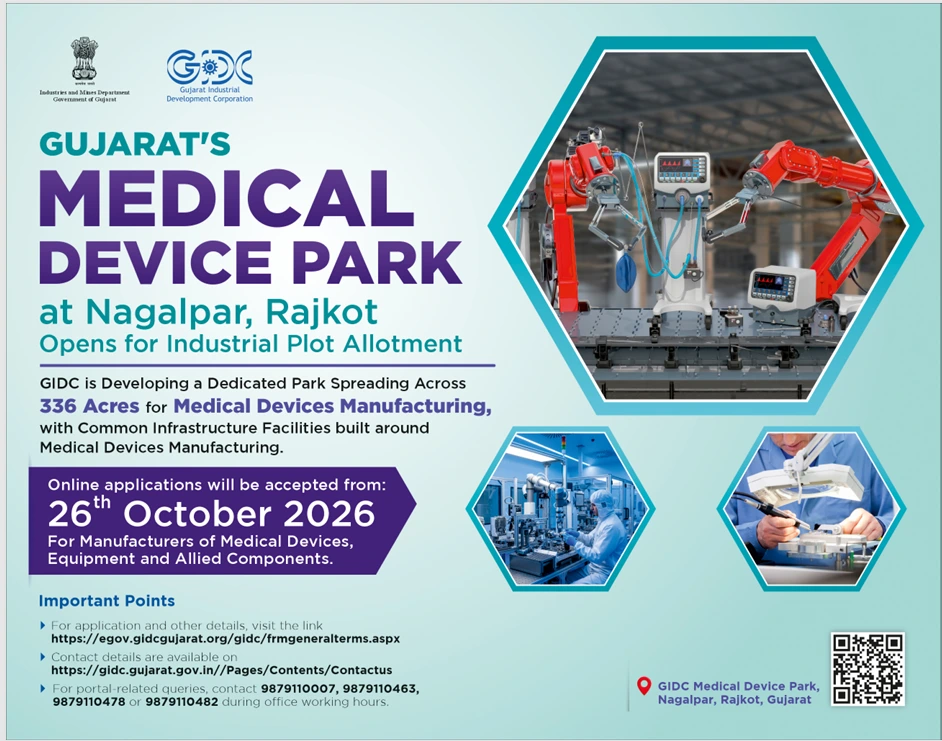
Medical Device Park at Nagalpar
The Nagalpar Medical Device Park was announced at the Vibrant Gujarat Regional Conference in January 2026 as part of the state’s strategy to become a national leader in medical device manufacturing.
The park is designed to create a comprehensive ecosystem for the medical device industry, supporting manufacturing, research and global export.
Planned infrastructure includes plug-and-play utilities, a water supply system with a proposed capacity of 3.5 million litres per day (MLD), a sewage treatment plant (STP) and solid waste management facilities. Land has also been earmarked for a proposed 66 kV substation to support power requirements. A common warehouse and logistics centre is planned to facilitate storage and distribution.
The park’s connectivity to major ports, including Kandla and Mundra, is also expected to support manufacturers targeting export markets.
India continues to depend on imports for a significant share of its medical device requirements. According to the government, imports account for around 60% of domestic medical device consumption.
As part of its efforts to make India Aatmanirbhar (self-reliant), the government has introduced several schemes to promote domestic medical device manufacturing.
Under the central government’s Scheme for Promotion of Medical Devices Parks, three parks are under implementation in Noida, Uttar Pradesh; Ujjain, Madhya Pradesh; and Kanchipuram, Tamil Nadu.
The scheme has an outlay of INR 400 crore and provides central financial assistance of up to INR 100 crore per park to support common facilities such as testing laboratories, sterilisation facilities, warehousing, incubation centres and prototyping infrastructure.
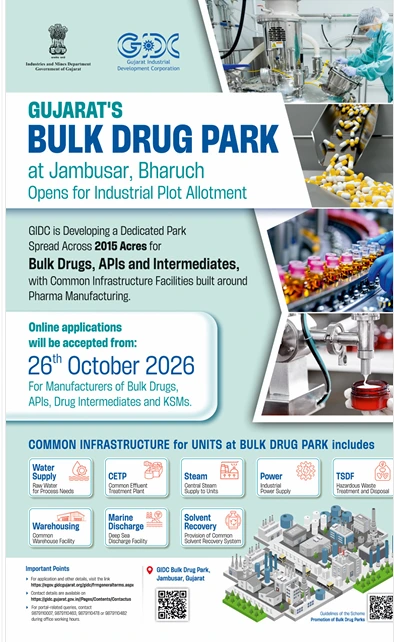
Bulk Drug Park at Jambusar
The 2,015-acre bulk drug park at Jambusar is being developed by GIDC to strengthen domestic pharmaceutical manufacturing and reduce dependence on imported bulk drugs and APIs.
The park is planned with common infrastructure facilities, including water supply, a common effluent treatment plant (CETP), central steam supply, industrial power supply, hazardous waste treatment and disposal, a common warehouse, a deep-sea discharge facility and a proposed common solvent recovery system.
Access to shared infrastructure is expected to help manufacturers reduce operating costs, improve resource utilisation and meet environmental compliance requirements.
The total project is estimated to cost INR 3,920 crore and is expected to be completed by March 2027.
In a progress update issued in March 2026, the Department of Pharmaceuticals said GIDC had utilised INR 341.44 crore out of INR 600 crore received in two instalments as central grant-in-aid. It had also utilised INR 206.92 crore out of INR 274.20 crore allocated from state funds towards developing common infrastructure facilities.
The department added that civil infrastructure tenders covering roads, drainage, water infrastructure and effluent collection and rack systems had been awarded, with most of the work completed on site.
Central Government Support for Bulk Drug Parks
The Department of Pharmaceuticals is implementing the Scheme for Promotion of Bulk Drug Parks, which was approved by the Union Cabinet on March 20, 2020. The scheme is intended to facilitate the setting up of three bulk drug parks across the country to reduce manufacturing costs by providing world-class common infrastructure and enabling economies of scale.
The three approved parks are located in Gujarat, Himachal Pradesh and Andhra Pradesh. Besides Jambusar in Gujarat, the projects are being developed in Haroli in Himachal Pradesh and K.P. Puram and Kodhada in Andhra Pradesh.
Under the scheme, central financial assistance is capped at INR 1,000 crore per park or 70% of the project cost for common infrastructure facilities, whichever is lower. For parks in north-eastern and Himalayan states, assistance can cover up to 90% of the project cost, subject to the scheme’s applicable limits.
Boosting India’s Pharmaceutical and Medical Device Manufacturing
India is the world’s third-largest pharmaceutical industry by volume and a major producer of APIs and bulk drugs. However, the country continues to import several pharmaceutical ingredients, with cost considerations being a key factor behind these imports.
The government has introduced several initiatives to encourage domestic manufacturing and reduce import dependence across the pharmaceutical and medical device sectors.
These include the Production Linked Incentive (PLI) scheme for the domestic manufacturing of KSMs, drug intermediates and APIs; the PLI scheme for pharmaceuticals; the Scheme for Strengthening of the Pharmaceutical Industry (SPI); the PLI scheme for promoting domestic manufacturing of medical devices; and the Scheme for Strengthening of the Medical Device Industry (SMDI).
The opening of Gujarat’s two industrial parks for plot allotment marks a further step in expanding dedicated manufacturing infrastructure for the pharmaceutical and medical technology sectors