





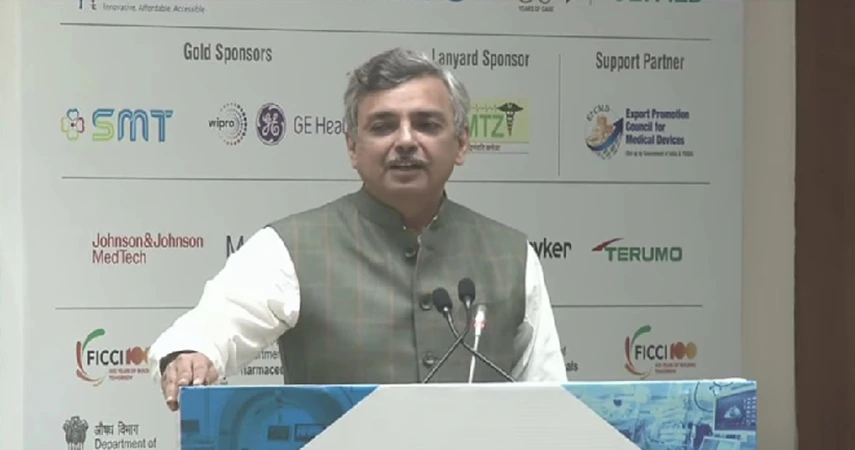
Manoj Joshi, secretary, Department of Pharmaceuticals, emphasised the need for medical device manufacturers to shift their strategy from producing primarily for India as an import-substitution sector to developing products for the global market.
In his keynote address at the 9th edition of India Medical Device 2026 at Vigyan Bhawan, New Delhi, on Friday, Joshi said this shift would require the development of component manufacturing facilities and a broader ecosystem that is currently lacking in India.
“In a large number of devices, you find that the more you go up on the value chain, it is more of assembly line operations or completely imports. So, I think development of the component industry is what is required if you want to cater to the global market and not to a limited Indian market,” he said.
According to Joshi, the Indian market is pretty large, valued at about $16 billion, but the global market is worth $600 billion.
Building Domestic Manufacturing Capabilities
Joshi said recent disruptions, including COVID-19 and the US-Iran conflict, have highlighted the need for India to reduce critical dependence on other countries. He said medical devices and pharmaceuticals should therefore be substantially manufactured domestically to ensure supply security during sudden disruptions.
To this end, he said the government gives greater importance to medical devices than other industrial products.
“In high-end medical devices, when we started pushing for more production, initially, we started seeing assembly-line operations. So, over the last five to seven years, we have seen a shift in high-end medical equipment from being completely imported to assembly in India. We are now seeing assembly of imaging devices and some robotics, but not much on the IVD diagnostics side,” he said.
Joshi said India has seen limited assembly activity in the IVD diagnostics segment, which is a complex and relatively closed market. He stressed the need to promote domestic assembly and reagent manufacturing to meet local demand and gradually expand into global markets.
Medical Device Startups Face Commercialisation Challenges
Joshi highlighted the rapid growth of medical device startups, particularly in IVD diagnostics, but said many face challenges in commercialising and selling their products.
“In PRIP, we had some 750 applications; out of those, about 500 were from medical device startups. Many startups have come up, and they are finding it challenging to sell their products. It is much easier in the medical devices sector to produce a prototype, slightly more difficult to produce a product, and far more difficult to sell that product,” Joshi said.
He suggested greater partnerships between large industry players and startups to help commercialise innovative products and expand market access.
Joshi said collaboration between large companies and medical device startups, which is common in the pharmaceutical sector, has not yet gained traction in medical devices. He suggested exploring whether large industry players could acquire designs and prototypes from startups, noting the sector has nearly 1,000–2,000 startups.
“This is one area which we need to strategize and plan and work better; otherwise we are wasting too much of everyone’s energy without reaching anywhere,” he added.
Raise Domestic Value Addition
Joshi said India needs to move beyond assembly operations by increasing domestic value addition and strengthening partnerships with the software and electronics industries. He said the goal should be to raise domestic value addition in high-end medical devices from 20–25% to 40–45%, noting that complete domestic manufacturing of such devices is not feasible.
The pharma secretary also stressed that efficient cross-border supply chains are essential to reduce costs, accelerate production and improve manufacturing systems.
“If you are making components in India, you need to make them for a market much larger than India. Those products need to move out faster, and even those components would probably have 50% of their parts coming from outside. So, value-chain development is something we have to keep in perspective, both from the regulatory side, so that there is easy and faster movement of components across borders,” he said.
Streamline Approvals, Strengthen Global Competitiveness
Joshi underscored the need to streamline approvals and provide greater flexibility to large industries to ensure smoother and faster production.
He added that government support, regulatory systems and market development should focus on strengthening domestic manufacturing and advancing the goals of Atmanirbhar Bharat and Viksit Bharat.
“The government would provide support to the medical devices sector so that more production takes place in India and the component industry is further developed. We should produce not just for India but for global markets, because that is what the future holds. If you are producing only for the Indian market, you will be swamped by imports with low import duties of up to 10%,” Joshi said.
“Let’s work together so that there is better product development, stronger brand building, better outreach, a faster regulatory system and faster movement across borders,” he concluded.