



Novo Nordisk has submitted a New Drug Application (NDA) to the US Food and Drug Administration (FDA) and a Marketing Authorisation Application (MAA) to the European Medicines Agency (EMA) for etavopivat, an investigational, once-daily oral therapy for adolescents and adults aged 12 years and older living with sickle cell disease (SCD).
If approved, etavopivat could offer a new disease-modifying treatment approach for people living with SCD.
The USFDA has previously granted etavopivat Fast Track, Rare Pediatric Disease and Orphan Drug designations and is expected to make a decision on the NDA in 2027.
In Europe, etavopivat has received Orphan Drug designation from the European Commission, with a decision on the MAA also expected in 2027. An MAA is the formal application seeking authorisation to market a medicine in the European Union (EU).
Martin Holst Lange, executive vice president, chief scientific officer and head of Research & Development at Novo Nordisk, said that severe vaso-occlusive crises and other symptoms of SCD can have a profound impact on the daily lives of people living with the disease, while treatment options remain limited.
“If approved, we are hopeful that etavopivat can provide a new disease-modifying treatment option for people living with sickle cell disease, and we will continue to work alongside the community to help advance health equity and overcome the longstanding disparities that impact those affected by this disease,” he said.
The regulatory submissions are supported by results from the HIBISCUS clinical study programme, which evaluated the efficacy and safety of etavopivat in adults and adolescents with SCD. The study assessed the annualised rate of vaso-occlusive crises (VOCs) at week 52 and the proportion of patients achieving a haemoglobin response (an increase of more than 1 g/dL) at week 24, compared with placebo.
Participants were also allowed to continue receiving standard-of-care treatment throughout the trial.
Topline results announced in April 2026 showed that etavopivat reduced the annualised rate of VOCs by 27% and delayed the time to the first VOC by approximately four months compared with placebo.
Understand sickle cell disease
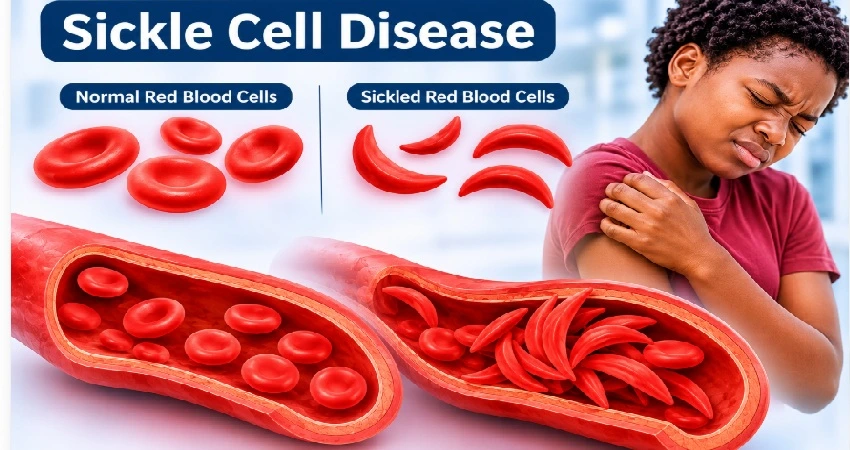
Sickle cell disease (SCD) is an inherited blood disorder caused by a mutation in the gene responsible for producing haemoglobin. The resulting abnormal haemoglobin, known as sickle haemoglobin (HbS), can polymerise under certain conditions, causing red blood cells to become rigid and sickle-shaped.
The two main hallmarks of SCD are haemolytic anaemia and vaso-occlusive crises (VOCs), which occur when sickled red blood cells obstruct blood flow through small blood vessels.
According to data cited by NOVO, an estimated eight million people worldwide are living with SCD, with the majority residing in low- and middle-income countries.
The disease can cause a range of acute and chronic complications, including acute chest syndrome, stroke, and kidney, liver and heart disease. Despite advances in treatment, many people with SCD continue to experience significant pain and have a life expectancy approximately 20 years shorter than that of the general population
How does etavopivat work?
Etavopivat is an investigational, once-daily oral selective activator of pyruvate kinase red blood cell isozyme (PKR), a key enzyme involved in glycolysis, the process through which cells generate energy.
In people with SCD, PKR activation reduces levels of 2,3-diphosphoglycerate (2,3-DPG) and increases the production of adenosine triphosphate (ATP).
Lower 2,3-DPG levels increase haemoglobin’s affinity for oxygen, helping prevent sickle haemoglobin polymerisation and the subsequent sickling of red blood cells. Increased ATP production helps maintain red blood cell membrane integrity and deformability, potentially improving red blood cell survival.
Through these mechanisms, etavopivat has the potential to reduce VOCs and improve haemoglobin levels, offering a disease-modifying approach to SCD treatment.
Novo Nordisk acquired etavopivat through its 2022 acquisition of Forma Therapeutics.