




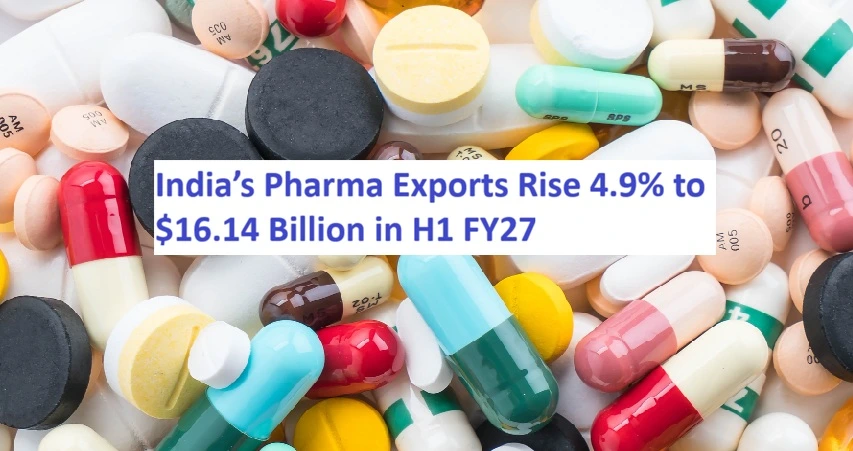
India’s pharmaceutical exports grew 4.90% year-on-year to USD 16.14 billion in the first half of FY27 (April–September 2026), up from USD 15.38 billion in the corresponding period of FY26, according to data released by the Pharmaceuticals Export Promotion Council of India (Pharmexcil).
The first-half performance was supported by growth in drug formulations and biologicals, bulk drugs and drug intermediates and surgical products, alongside gains across several international markets.
During the second quarter of FY27 (July–September 2026), pharmaceutical exports increased 3.05% year-on-year to USD 8.04 billion, compared with USD 7.80 billion in the corresponding quarter of the previous financial year. September recorded the highest monthly export value during the first half, at USD 2,744.05 million, representing a 4.68% increase over September 2025.
Europe accounts for over one-fifth of exports
Europe remained a significant destination for Indian pharmaceutical products during H1 FY27, with exports to the region rising 9.66% year-on-year to USD 3.29 billion. The region accounted for 20.38% of India’s total pharmaceutical exports during the period.
Among major European markets, exports to Germany increased 21.57%, while the Netherlands and France recorded growth of 15.93% and 15.02%, respectively.
Pharmexcil noted that the growth across these markets highlights opportunities for Indian pharmaceutical exporters to deepen their engagement with Europe.
Other regions also recorded growth during H1 FY27. Exports to the Association of Southeast Asian Nations (ASEAN) increased 21.54%, while Latin America and the Caribbean registered growth of 16.58%. Exports to Africa rose 6.48%.
Pharmexci said the gains across these markets helped sustain India’s overall pharmaceutical export growth even as shipments to the United States moderated, highlighting the importance of diversifying India’s pharmaceutical export destinations.
Drug formulations and biologicals remain the largest category
Drug formulations and biologicals remained India’s largest pharmaceutical export category, accounting for 73.84% of total shipments during H1 FY27. Exports in this segment grew 3.81% year-on-year.
Bulk drugs and drug intermediates recorded stronger growth of 12.07%, while surgical product exports increased 9.53%.
“The next phase of our growth should focus on moving up the value chain, where Indian companies are not just suppliers but active partners in pharmaceutical innovation.“
Pharmexcil calls for a shift towards higher-value products
Namit Joshi, chairman of Pharmexcil, said India’s global pharmaceutical reputation has been built on the strength of quality, affordable medicines and large-scale manufacturing.
He said the next phase of growth should focus on moving up the value chain, with Indian companies becoming active partners in pharmaceutical innovation rather than remaining suppliers.
“This will require greater investment in research and development, technology transfer and co-development of complex generics, biosimilars and specialised therapies,” Joshi said, noting that Europe offers significant opportunities for such collaborations, given its strong research and innovation ecosystem.
“By combining India’s manufacturing and formulation expertise with global technological capabilities, we can create opportunities for Indian companies to participate in higher-value segments of the pharmaceutical industry,” he added.
Bhavin Mehta, vice chairman of Pharmexcil, said the double-digit growth in bulk drugs and drug intermediates reflects the breadth of India’s pharmaceutical manufacturing capabilities.
“The expansion of exports across Europe, ASEAN, Latin America and Africa also demonstrates the opportunities available to companies across the value chain. Continued investment in quality systems, advanced manufacturing and regulatory preparedness can support greater global participation by Indian exporters, including MSMEs,’ Mehta said.
Pharmexcil said it would continue to work with the Government of India, the pharmaceutical industry, overseas regulators and international stakeholders to strengthen market access, regulatory cooperation and the global competitiveness of Indian pharmaceutical exporters.
The Council will also support greater engagement across established and emerging markets, alongside efforts to expand India’s presence in higher-value, innovation-led pharmaceutical products.