





Prostate cancer is the second leading cause of cancer-related deaths among men after lung cancer. It is projected that annual prostate cancer cases worldwide could rise from 1.4 million in 2020 to 2.9 million by 2040. In India, prostate cancer accounts for nearly three per cent of all cancers, with around 33,000 to 42,000 new cases diagnosed every year, according to a study published in The Lancet.
Early diagnosis and timely intervention are key to saving lives. However, due to low awareness of prostate cancer and delayed diagnosis, many patients are identified only after the disease has already spread, contributing to high mortality rates. The Lancet study also highlighted that late diagnosis is particularly common in low- and middle-income countries (LMICs). Researchers stressed that establishing systems for earlier detection is essential to reduce the growing burden of the disease.
Against this backdrop, robot-assisted prostate biopsy technologies are emerging as a promising solution for improving the detection of clinically significant prostate cancer. One such innovation is the Mona Lisa robotic system developed by Singapore-based Biobot Surgical. The platform combines MRI and ultrasound imaging to perform highly targeted prostate biopsies with greater precision than conventional transrectal biopsy methods.
The technology has already been introduced in several countries, including the US, China, Australia, Europe and across the Asia-Pacific region.
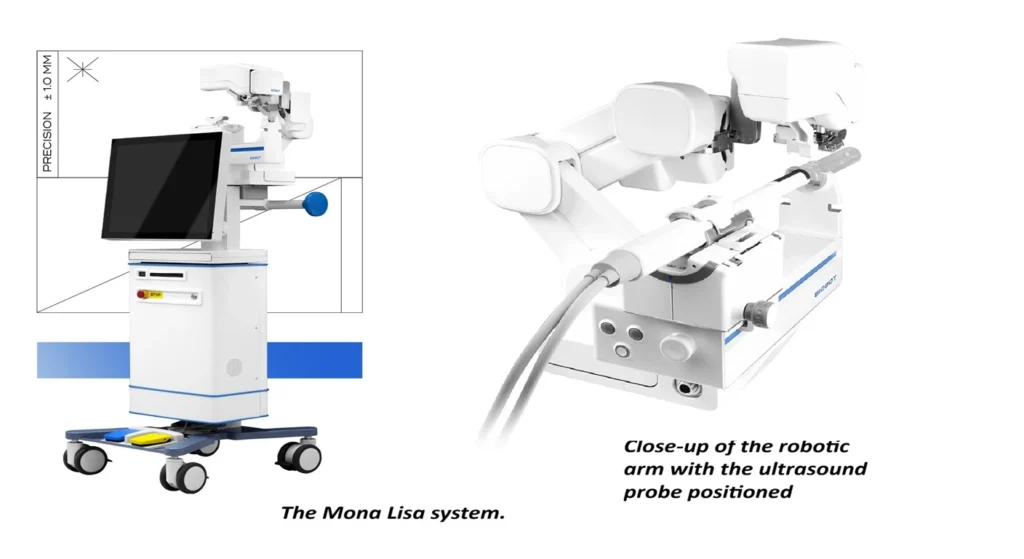
Photo: Biobot Surgical
How the Mona Lisa System Works
The Mona Lisa system is a robotic transperineal prostate biopsy platform equipped with MRI-ultrasound fusion capability. It is designed to help physicians perform targeted biopsies with greater accuracy and ease.
The system includes two major components — a touch-screen control system and a robotic arm. The control system allows clinicians to plan and monitor the procedure, while the robotic arm assists in positioning the ultrasound probe and guiding the biopsy needle during the procedure.
Its software algorithm enables flexible biopsy planning, while the robotic needle guide automates needle positioning and depth control. This helps physicians collect targeted biopsy samples even from difficult-to-reach areas such as the apex, anterior and peripheral regions of the prostate.
The system also uses a specially designed probe sheath that enables the ultrasound probe to move unobstructed, minimizing prostate deformation and providing essential stabilization for accurate sampling.
One of Mona Lisa’s key features is its “dual cone” approach, which minimizes pubic arch interference and allows multiple needle entry points for wider prostate coverage.
With a single click, MRI and ultrasound images can be fused to create a 3D visualization of the prostate, enabling physicians to accurately target regions of interest.
Lower Infection Risk Compared to Traditional Biopsies
Unlike traditional transrectal biopsies, the Mona Lisa-guided procedure is performed through the perineal skin rather than through the rectum. This significantly lowers the risk of infection and bleeding associated with conventional biopsy methods.
The procedure is also considered less invasive, with faster recovery times for patients. It is performed under general anesthesia, which can improve patient comfort during the biopsy process.
Clinical Evidence and Global Expansion
A study published in BJUI highlighted the effectiveness and safety of the Biobot robotic system in assisting urologists with prostate biopsies.
More recently, a study published in Nature on February 25, 2026, reported the first European experience using the Mona Lisa 2.0 robotic platform for MRI/ultrasound transperineal targeted prostate biopsy.
The upgraded Mona Lisa 2.0 system integrates MRI-ultrasound fusion, AI-based prostate segmentation and automated needle trajectory planning to further improve biopsy precision.
The European study involved 10 consecutive patients undergoing robot-assisted targeted biopsies, with optional systematic sampling. Clinically significant prostate cancer was detected in all robot-assisted targeted biopsy procedures.
Researchers concluded that the preliminary data demonstrated the feasibility, safety and reproducibility of the Mona Lisa 2.0 platform, describing it as “a new kid on the block in urologic robotic armamentarium.”
Regulatory Clearances and Future Plans
Biobot’s first-generation Mona Lisa or Mona Lisa [Dx] for targeted prostate biopsies has received regulatory clearances from the US FDA, China’s NMPA, Australia’s TGA, Singapore’s HSA and European CE authorities.
The advanced Mona Lisa 2.0 platform has expanded indications beyond prostate biopsies to include positioning for soft tissue ablation procedures. It has also received FDA, CE, TGA and HSA approvals.
Biobot Surgical said it continues to invest in expanding the system’s digital infrastructure, indications and access across different sites of care. The company added that its next-generation platform, “Mona Lisa Access,” is currently under development.