






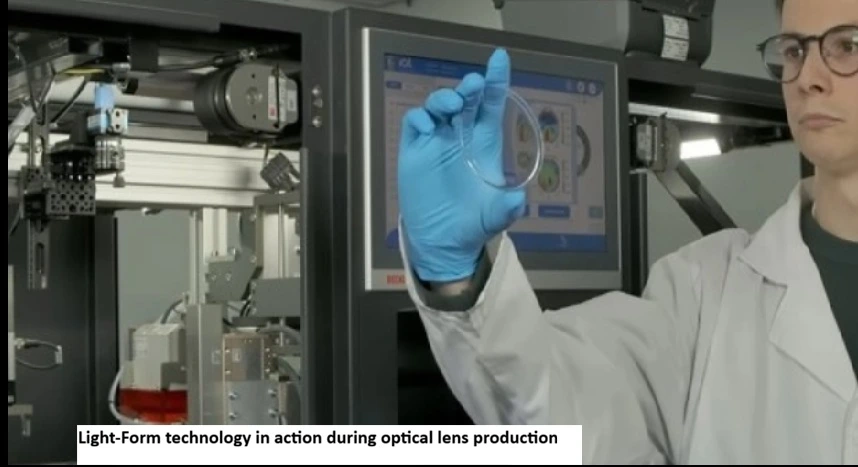
IOT, a technology company specialising in innovative solutions for the ophthalmic lens industry, has developed Light-Form Technology, an additive manufacturing process that produces fully personalised progressive lenses using a single flash of light.
The breakthrough combines volumetric lens formation with the optical precision and quality required for commercialisation, marking what IOT describes as a world first in personalised progressive lens manufacturing.
Light-Form is based on stabilised frontal photopolymerisation, a process that uses light to form the lens volume in a single step. Unlike conventional lens surfacing methods, it eliminates the need for generating and polishing.
The process also incorporates resin recovery to minimise waste, followed by surface hardening and lens mapping. While the lens formation itself takes just seconds, subsequent processing completes the production workflow.
“Light-Form demonstrates how scientific research can change the way ophthalmic lenses are made,” said José Alonso, Co-founder and CINO of IOT.
“Combining optical precision with a new manufacturing process opens new possibilities, helping optical partners develop personalised solutions, explore new lens architectures and manufacture with greater flexibility,” he added.
The technology brings additive manufacturing into prescription optics while meeting the stringent quality requirements of commercial optical production.
For personalised progressive lenses, a new manufacturing method must accurately reproduce the intended optical design rather than simply create a recognisable lens shape. Light-Form combines the flexibility of digital manufacturing with these demanding optical requirements, potentially expanding opportunities for new lens architectures and individualised solutions.
IOT predicts that future production models could include systems with multiple printing heads to increase output within a compact footprint.
The company also envisages the possibility of in-store manufacturing using smaller equipment, potentially bringing customised lens production closer to consumers while reducing inventory requirements and operational complexity.
“The value lies in rethinking the production workflow,” said Carolina Gago, COO of IOT.
“Resin recovery and lower water and energy requirements address how resources are used, while compact equipment could support production closer to consumers. We are working to translate these capabilities into practical manufacturing options,” she added.
Another potential development area is the direct printing of prescription optics onto waveguides and flat substrates for smart glasses and augmented reality (AR) devices, potentially enabling thinner and lighter designs.
The ability to create customised optical geometries could also support future virtual reality (VR) applications. However, these remain development opportunities and are distinct from the progressive lenses already reaching consumers, according to the company.
For optical laboratories, the technology could provide greater flexibility in determining production locations and organising manufacturing capacity. Rather than relying exclusively on conventional surfacing infrastructure, future installations could be configured to meet local demand.
For consumers, the longer-term potential lies in accessing personalised prescription lenses through a more responsive production model, while optical partners continue to play a central role in vision correction and personalised services.
According to IOT, Light-Form can also reduce the environmental footprint of ophthalmic lens manufacturing by eliminating water consumption during the manufacturing process and lowering energy use and material waste. Resin recovery further contributes to improved material efficiency.
Compared with conventional manufacturing methods, Light-Form eliminates manufacturing water consumption, reduces energy use by 90% and cuts waste by 76%, according to the company.