






Strengthening India’s API manufacturing capabilities is essential for the country to become an innovation hub and reduce its dependence on imports from China, according to Dr Shipra Pandey, Deputy Manager – International Business Development, Ratnatris Pharmaceuticals.
Around 70–80% of Ratnatris Pharmaceuticals’ API requirements are currently sourced from China, Dr Pandey said.
Speaking to Health Xplore on the sidelines of iPHEX 2026, Dr Pandey discussed Ratnatris Pharmaceuticals’ international market expansion plans, what foreign buyers look for from Indian pharmaceutical companies, India’s dependence on Chinese APIs and the need for greater investment in research and innovation.
Ratnatris Pharmaceuticals, a subsidiary of Senores Pharmaceuticals, focuses on the manufacturing and development of affordable, high-quality generic medicines. The company is export-focused and operates a manufacturing facility in Ahmedabad, Gujarat. It currently supplies complex generic medicines to more than 50 countries across five continents.
Dr Pandey oversees the company’s international business development across Europe, the Middle East and North Africa (MENA), Asia, the Commonwealth of Independent States (CIS) and rest-of-the-world (ROW) markets.
Interview with Dr Shipra Pandey
Q. What are the untapped markets Ratnatris Pharmaceuticals is currently targeting?
There are several markets that we are currently exploring. We are particularly interested in Saudi Arabia, the UAE, Latin American markets such as Colombia and Mexico, as well as Oman and Qatar.
Q. What are the major challenges in entering these markets?
The global pharmaceutical market can broadly be divided into three categories: stringent or highly regulated markets such as the US and Europe; semi-regulated or ROW markets, including several countries in the Middle East and Southeast Asia; and non-regulated markets, including Pakistan and Afghanistan.
As we look to enter more regulated markets such as Colombia, the UAE and Saudi Arabia, we face a different set of challenges. Our facility and operations have historically been geared towards ROW markets, so entering highly regulated markets requires us to strengthen several areas.
The facility itself has to meet stringent standards, while documentation and compliance processes have to be extremely robust. These are some of the challenges we are currently addressing. However, as we enter these markets one by one, we will gain a better understanding of their requirements and how to navigate them.
The molecules we have selected and the distributors we have identified in these regulated markets are not major concerns. The bigger challenge is manpower. We need technically strong people and business teams who are well-versed in those regulated markets and understand the kind of queries, regulatory requirements and challenges we are likely to encounter.
Hiring professionals with prior experience in these markets can be extremely valuable. They can guide us on the kind of facilities and systems required, identify gaps in our manufacturing processes and help us address those issues before entering the market.
Our manufacturing capabilities and the way we produce our medicines are already strong, which is one of the reasons we have performed well in ROW markets. However, regulated markets have additional requirements. Having the right technical team with relevant market experience will be one of the most important factors in helping us make that transition successfully.
Q. Do you think international collaboration can help address these challenges?
Yes, international collaboration can certainly help. For example, working with local agents or partners can help us identify market-specific requirements and potential challenges.
These partners understand their local markets because they have been operating there and understand the regulatory and business environment in detail. Their insights can help us identify issues early and prepare ourselves accordingly.
Q. What do foreign buyers mainly look for from Indian pharmaceutical companies?
India is known as the pharmacy of the world and is one of the leading manufacturers of generic medicines globally. The first thing foreign buyers look for is affordable, quality medicines, which is something India can offer because of its large manufacturing base.
However, buyers also look for companies with which they can build long-term relationships. The pharmaceutical business is not something where you can easily switch from one partner to another. A significant amount of regulatory work is involved.
For example, a particular molecule has to be registered in the country where it is going to be marketed. Registration requires significant investment and time. In markets such as Malaysia and the Philippines, registration of a product can take around 18 to 24 months. When so much time and investment are involved in registering a molecule, distributors naturally expect a long-term relationship with the manufacturer.
At Ratnatris, we have a minimum five-year contract with our distributors, and distributors generally expect to have at least five years of business with us once a molecule is registered.
So, foreign buyers are looking not only for affordable and quality products but also for reliability, regulatory capability and long-term partnerships.
Q. How would you compare the Indian and Chinese pharmaceutical industries?
China is the world’s largest manufacturer of active pharmaceutical ingredients (APIs). A finished pharmaceutical formulation requires APIs, and China has a very strong position in this segment.
However, India is ahead in terms of finished formulations. If we compare the two countries in this area, India has a strong advantage because of the large number of quality finished formulation manufacturers operating in the country.
I don’t think buyers necessarily compare India and China directly across the entire pharmaceutical value chain. In the API market, however, China remains a dominant player and is widely recognised globally.
India also has many API manufacturers, but we have not yet achieved the same level of global exposure and acceptance as China in this segment. That remains a challenge.
At Ratnatris, our focus has primarily been on finished formulations, and India is already ahead in this area.
Q. Though we talk about Viksit Bharat, the Indian pharmaceutical industry still largely depends on China for APIs. Is that also the case for Ratnatris?
Yes, to a significant extent. Around 70–80% of our API requirements are sourced from China. This is because Chinese manufacturers offer good-quality APIs at competitive prices.
I would not say Indian APIs are of lower quality. Pharmaceutical products are governed by data and quality testing. We cannot simply compare two countries or manufacturers. The quality and compliance data have to speak for themselves.
For our company, Chinese APIs are particularly suitable for ROW markets because they are widely accepted, cost-effective and supported by an established supply base.
However, the situation can be different in regulated markets. For example, if we want to manufacture and sell a product in the US, there may be specific requirements around the source of the API and the regulatory acceptability of that supplier. This can create additional challenges.
For ROW markets, Chinese APIs are generally acceptable, partly because China has an established position in the global API industry and has built significant experience and trust over the years.
At the same time, we do source from Indian manufacturers as well. Costing is always an important factor. If we are unable to obtain competitive pricing directly from Chinese manufacturers, we may work with Indian vendors who can source the required APIs from China or provide suitable alternatives.
Q. As India seeks to become an innovation hub, do you agree that strengthening API manufacturing should be a priority?
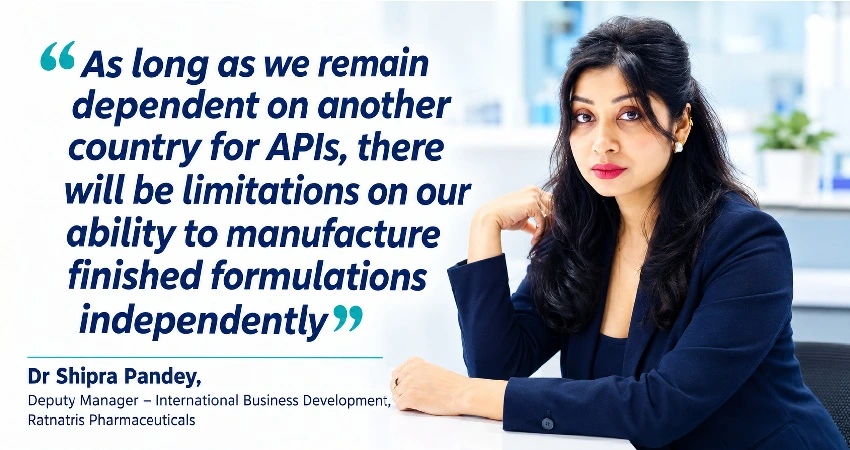
Yes, absolutely. As long as we remain dependent on another country for APIs, there will be limitations on our ability to manufacture finished formulations independently.
APIs are essential for producing pharmaceutical products. If India strengthens its API manufacturing capabilities, we can reduce our dependence on imports. It could also help reduce costs because we would not have to import APIs from other countries.
So, strengthening the domestic API industry would definitely be beneficial for India.
Q. What should Indian API manufacturers focus on to become more competitive with Chinese companies?
The fundamentals are similar to those for finished formulations. Manufacturers need to continue focusing on quality, improving processes and developing molecules that meet global standards.
Another important factor is investment in research and innovation. If you look at the amount of money being dedicated to innovation in India, it is still relatively low.
Developing a new molecule requires substantial investment, often running into crores of rupees. Without adequate funding for innovation and development, it becomes difficult to create high-quality molecules domestically. Therefore, greater investment in research, innovation and API development is essential.