






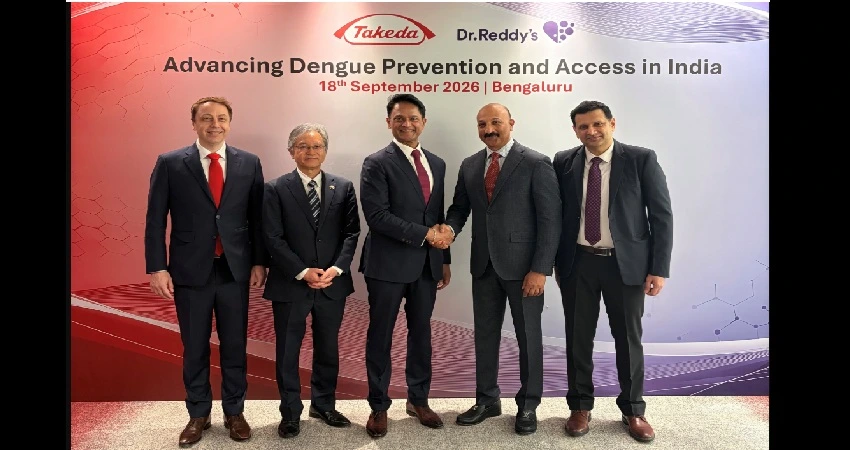
Dr. Reddy’s Laboratories and Takeda have entered into a distribution agreement to promote and distribute QDENGA, Takeda’s dengue vaccine, across India’s private market for paediatric and adult vaccination.
Subject to completion of applicable processes with local authorities, the vaccine is expected to become available in India in the first half of 2027.
The partnership follows the Central Drugs Standard Control Organisation’s (CDSCO) approval of QDENGA’s marketing authorisation in July 2026 for individuals aged 4 to 60 years. The approval makes QDENGA the first dengue vaccine approved in India.
Under the agreement, Dr. Reddy’s will serve as Takeda’s exclusive partner for the promotion and distribution of QDENGA in the private market for paediatric and adult vaccination.
Takeda will retain the rights to promote and distribute QDENGA in India’s public market, as well as legal ownership and overall medical and brand oversight of the vaccine in the country.
The companies will also support healthcare-professional engagement and disease awareness, in accordance with applicable regulatory requirements.
M.V. Ramana, CEO – Global Generics, Dr. Reddy’s Laboratories said, “Through our collaboration with Takeda, we look forward to making QDENGA available to eligible individuals and contributing to efforts aimed at addressing the country’s dengue burden.”
Dr. Mahender Nayak, Head of Intercontinental Markets, International Business Unit, Takeda, said the company remains focused on supporting India’s evolving healthcare needs and expanding access to dengue vaccination.
“Our private-market collaboration with Dr. Reddy’s will help enable timely private-market access for eligible individuals once QDENGA becomes available in India,” he said.
Since 2022, Takeda’s dengue vaccine has been approved in 43 countries, including India. The World Health Organization (WHO) has recommended QDENGA for use in high-endemic countries without the need for pre-vaccination screening. The vaccine is also included in the WHO’s List of Prequalified Vaccines.
Dengue continues to pose a significant public health challenge in India. According to Dr. Reddy’s, reported cases have increased 11-fold over the past two decades. The company cited a nationwide dengue surveillance study conducted by the Virus Research and Diagnostic Laboratory of the Indian Council of Medical Research, which revealed that all four dengue virus serotypes (DENV-1 to DENV-4) are co-circulating across multiple regions in India, with 1 in 14 patients infected with multiple dengue serotypes concurrently.
QDENGA, also known as TAK-003, is a live-attenuated tetravalent dengue vaccine based on a DENV-2 backbone, incorporating structural proteins from DENV-1, DENV-3 and DENV-4, enabling broad immune coverage across all four dengue serotypes. The vaccine is administered in a two-dose schedule, with the doses given three months apart.