






India has established itself as a major global supplier of medicines, earning recognition as the “pharmacy of the world”. As the country looks towards 2047, the focus is increasingly shifting from manufacturing at scale to strengthening its capabilities in innovation and R&D. However, several gaps will need to be addressed to reach this goal
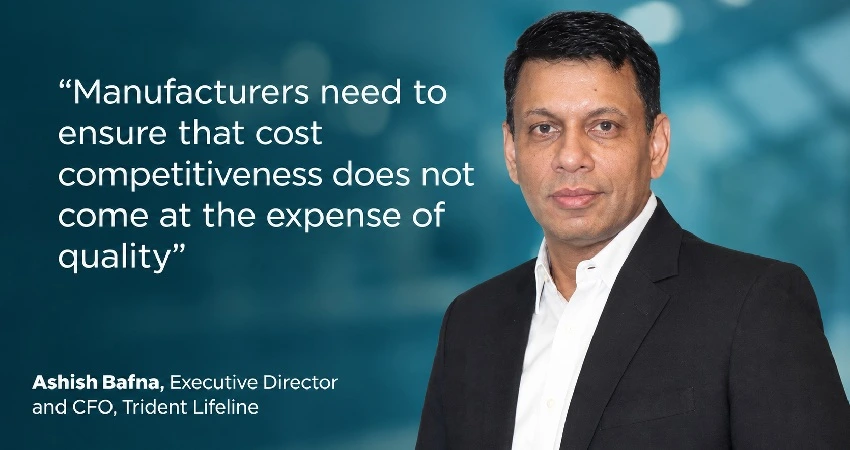
Speaking to Health Xplore on the sidelines of iPHEX 2026, Ashish Bafna, Executive Director and CFO, Trident Lifeline, emphasised the need for Indian pharmaceutical companies to place greater emphasis on quality and therapeutic effectiveness rather than competing primarily on price. He also called for greater alignment in policies and incentive schemes across states to create a more level playing field for pharma manufacturers competing in global markets.
Organised by the Pharmaceuticals Export Promotion Council of India (Pharmexcil), with the support of the Department of Commerce, the 12th edition of iPHEX was held from September 7–9 at Bharat Mandapam, New Delhi.
Interview with Ashish Bafna, Executive Director and CFO, Trident Lifeline Ltd.
Q. What are you expecting from iPHEX 2026?
Trident Lifeline is a pharmaceutical formulation manufacturing company based in Surat, Gujarat, building an institution of trust in pharmaceutical manufacturing.
This is our fifth consecutive year of participation in iPHEX. The exhibition allows us to meet overseas buyers from different markets. Since we are present in more than 46 countries, buyers from several of these markets visit iPHEX. Meeting our executives in person and seeing our product range helps build confidence in our capabilities.
Many of the customers we met at the previous edition have now concluded their discussions with us. We have also built a database of overseas buyers who have interacted with our marketing team, and we expect these relationships to translate into business opportunities in the coming years.
Q. What new markets are you targeting this year through iPHEX?
We are already present in Africa, Latin America and the CIS countries. We are now looking to expand into Southeast Asia and East Asia. There are also several untapped markets within the CIS and Latin American regions that we are looking to explore.
We have also had potential business contacts from Russia, Ukraine and Belarus. These are prospective markets for us as well.
Q. Do you face any challenges in reaching these markets?
The main challenge is that our facility is WHO-GMP approved, but we do not have EU-GMP certification yet. This limits our access to certain highly regulated markets.
There are markets governed by EU regulations where products cannot be registered without the required EU certification. We are therefore in the process of obtaining EU-GMP certification.
The rest of the world itself is a very large market, and as a growing company, we still have significant opportunities there. We are currently expanding at a good pace, and the rest-of-the-world (ROW) market provides us with considerable scope for growth.
The US market may come at a later stage, but the EU is an immediate target for us. We expect to obtain EU-GMP certification by next year.
Q. Is it very difficult to obtain EU-GMP certification?
No, it is not difficult; it is a journey.
Whenever you start a new plant, you initially cater to non-regulated and semi-regulated markets. As you move into highly regulated markets, your cost of production increases, so you first need to establish yourself.
Once the business is established, you are in a better position to make the necessary investments. Our cash flow is now generating the capacity to incur these additional costs and get our plant and products registered for the European market.
We are therefore taking a step-by-step approach rather than moving directly into the EU market.
Q. India has traditionally been known as a generic medicines manufacturer, but the focus is now shifting towards innovation and R&D. What is your company doing in this area?
We have dedicated R&D and formulation and development (F&D) teams at our manufacturing facility.
Our regulatory team also continuously monitors products that are expected to go off-patent over the next four to five years. Based on this, our teams work on developing those molecules in-house.
In addition, we have tie-ups with R&D centres. Whenever new ideas or molecules emerge that address an unmet or emerging need, our teams work on them. Once a formulation is developed, we try to take it to the market.
Q. What do you see as some of the bigger challenges India’s pharmaceutical industry faces in shifting from being the “pharmacy of the world” towards greater innovation?
Quality is one of the biggest issues.In India, we often tend to focus heavily on keeping costs low, partly because of the volumes involved. However, medicines cannot be viewed simply in terms of price; they have to be effective.
To compete in global markets, manufacturers need to ensure that cost competitiveness does not come at the expense of quality.
If you provide the right medicines with the right quality, your market and customer base will grow, while the effectiveness and efficiency of the manufacturing operation will also improve.
At Trident, we are focused on quality and trust. Ultimately, we are dealing with human lives. You cannot provide anything that could harm or adversely affect a patient. We claim that none of our batches has been rejected in any of the tests conducted so far.
Technology is another challenge. Companies do not always want to invest heavily in technology because it requires substantial capital.
Innovation is not a one-day or one-year process. It is continuous and can take years. A company may start working on a particular area today, but it could take 10 years before a molecule is successfully developed.
That requires patience as well as sustained capital investment. Even large corporates may not always have the bandwidth for such long-term investments.
Q. Is there any support you would like from the government?
Definitely. The government is introducing various incentive schemes and subsidies, but India has many states, and each state has its own policies. The Centre also has its own policies. There needs to be greater alignment among these policies.
For example, if one company is based in Gujarat and another in Maharashtra, differences in state-level incentives can affect their competitiveness in international markets. I would therefore request the government to develop a more uniform framework.
There should not be significant variations in the level of support available across states. In some states, capital subsidies are substantial, while in others they may be limited or unavailable. Such differences can directly affect manufacturing and project costs and, in turn, a company’s ability to compete globally.
The government is certainly providing different forms of support, but greater synchronisation across states would help create a more level playing field for Indian manufacturers competing in international markets.
Q. Given these challenges, how long do you think India will take to reach a higher level of innovation?
India is developing very fast. Innovation is now emerging even among small, micro and medium-sized enterprises, with companies increasingly investing in new technologies and R&D to develop new drugs.
India is moving in the right direction, and its presence in the global pharmaceutical market has increased significantly. Consumers in many countries appreciate Indian medicines for their quality and competitive prices.
Q. What is Trident Lifeline currently focusing on, and what are your plans for the near future?
Currently, we have four different manufacturing units covering tablets, capsules, liquids, ointments, dry powders, injectables and medical devices. We are also coming up with a pharma complex where five different manufacturing units will be established over the next four to five years.
Our aim is to expand across multiple healthcare segments, including cosmetics and nutraceuticals. From preventive healthcare to treatment, we want to build a comprehensive product portfolio and become a one-stop solution for our distributors and customers.